

Nanomaterial Customization Service | Ultrasmall 2 nm Ruthenium Nanozymes in Biomaterials Discovery for Modulating Periodontal Bone Defects

Research Rationale
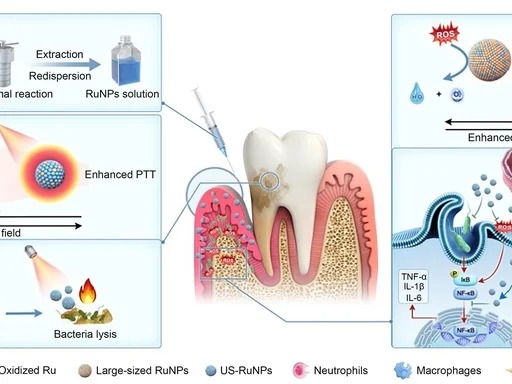
Proliferation of pathogenic bacteria and excessive accumulation of reactive oxygen species within periodontitis lesions continuously trigger inflammation and alveolar bone destruction. Conventional antibacterial and anti inflammatory strategies rarely eliminate biofilms, relieve oxidative stress, and restore bone metabolic homeostasis simultaneously. In this work, ultrasmall ruthenium nanoparticles (~2 nm) are fabricated. Relying on the synergy of their tunable multienzyme mimicking activity and photothermal effect, these nanoparticles remodel the periodontal microenvironment and achieve triple functions of bacteriostasis, antioxidation, and inhibition of bone resorption in animal models of periodontitis.
Material Development
(1) Materials: Ultrasmall ruthenium nanoparticles (US RuNPs) with a particle size of approximately 2 nm are synthesized via a hydrothermal reduction method. Their structure and catalytic performance are characterized in comparison with larger sized ruthenium nanomaterials.
(2) Functions:
① Possess multiple antioxidant enzyme mimicking activities, efficiently scavenge excessive reactive oxygen species in lesions and suppress inflammatory cascades;
② Local electric field enhances near infrared photothermal performance to eradicate planktonic pathogenic bacteria and dental plaque biofilms;
③ Alleviate oxidative stress mediated imbalance of bone metabolism, improve deposition of periodontal collagen fibers and reduce pathological loss of alveolar bone.
17768014569 (Dr.Gao)
17761925168 (Dr. Zhang)
18013729810 (Dr. Yang)
18915694570
Previous: Daily Ophthalmology Re
Next: Custom‑Tailored


