

Daily Ophthalmology Research Idea | Wireless Smart Contact Lenses: New Advances in Ophthalmic Health Management and Function Enhancement
(1) Abstract
Wireless smart contact lenses (WSCLs) are a non-invasive wireless multifunctional eye-wearable platform integrating energy harvesters, sensors, photodetectors, transistors, and wireless communication units. They enable continuous monitoring of ocular physical, chemical, and physiological signals, as well as eye-movement encoding. This review systematically summarizes recent progress in WSCLs regarding substrate materials, multifunctional coils, capacitive components, circuit design, and fabrication processes, and outlines their application prospects in health monitoring, disease treatment, and human-machine interaction.
(2) Background
Human eyes contain abundant physiological and biochemical information useful for diagnosing and treating ocular and systemic diseases, and a large proportion of brain information is transmitted through the eyes. WSCLs offer new possibilities for recording ocular information, enabling precise diagnosis and treatment, and realizing eye-machine interaction. However, challenges remain in material selection, structural optimization, circuit integration, and fabrication.
(3) Main Content
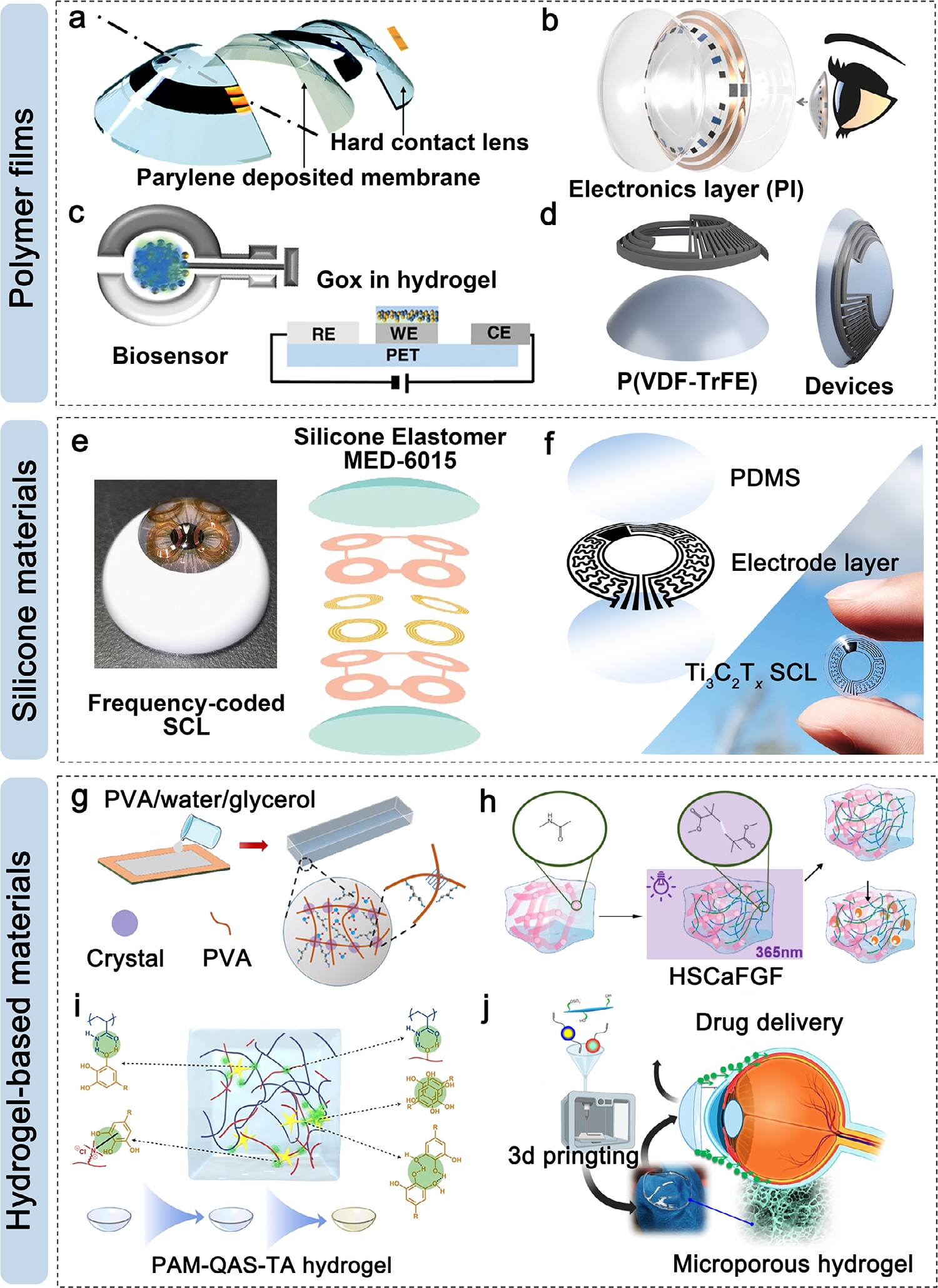
The review first analyzes substrate materials, including polymer films, silicone materials, hydrogels, and silicone hydrogels, focusing on the relationship between material selection and structural design. It then introduces multifunctional coil designs, covering metallic materials, nanomaterials, liquid metals, and polymer composites, as well as geometric configurations. Next, it describes capacitor classification and special structural designs, along with wireless circuit typologies and their functional contributions. Finally, it summarizes fabrication processes such as photolithography, soft lithography, and innovative deposition methods, and outlines WSCL applications in health monitoring, therapeutic delivery, and human-machine interaction.
(4) Study Design
As a review article, this paper systematically analyzes WSCL substrates, multifunctional coils, and capacitive components, emphasizing the interrelationships among material selection, structural optimization, and performance parameters. It then delineates WSCL circuit configurations, focusing on the functional contributions of individual components. Fabrication processes tailored for diverse material types are analyzed. Finally, application prospects in health monitoring, disease treatment, and human-machine interaction are comprehensively summarized, with a forward-looking perspective on future development.
(5) Results
The review indicates that silicone hydrogels are ideal for long-term wear due to their high oxygen permeability and water content. Polymer composites achieve a balance between conductivity and flexible transparency for coil materials. Microstructured dielectric layers and special geometric configurations effectively enhance capacitive sensing sensitivity. Wireless communication schemes include LCR resonant circuits, NFC, Bluetooth, and RFID, each with specific applicable scenarios. Photolithography and soft lithography remain mainstream fabrication techniques, while spray coating, electrohydrodynamic printing, and automated nozzle injection are rapidly developing. WSCLs have enabled wireless monitoring of intraocular pressure, glucose, cortisol, cholesterol, and MMP-9, and expanded into drug delivery, physical therapy, and human-machine interaction.
(6) Future Directions
Future WSCL development will evolve toward neural integration by establishing real-time neural feedback systems that convert corneal electrical activity and microsaccadic signals into actionable outputs. For visual restoration, optogenetic stimulation or microcurrent modulation may offer new approaches for degenerative retinal diseases. Neural-compatible materials, multimodal signal fusion algorithms, and long-term biosafety remain key directions for future breakthroughs.
We provide full-process services for various material designs (including highly innovative scheme design, preparation, characterization, in vitro and in vivo validation (cell/animal experiments), etc.): a postdoctoral team (with multiple high-impact publications in Zone 1 journals) can meet all kinds of tricky and challenging requirements, including hydrogels / drug delivery / nanomaterials / polymers / liposomes / microneedle drug delivery, etc. We can assist with project design / NSFC grant applications / publication of high-impact Zone 1 and Zone 2 papers in journals such as AFM, SCI, AM, etc. Welcome to consult 👇️
17768014569 (Senior Engineer Gao)
17761925168 (Engineer Zhang)
18013729810 (Engineer Yang)
18915694570
Previous: Custom Nanomaterial Se
Next: Custom‑Tailored


