

Custom Nanomaterial Services | Nanoparticles in Advanced Materials for Tumor Surgical Theranostics

 (1) Journal Source: Advanced Materials
(2) Title: Protein Degradation Nanoparticles for Intraoperative Fluorescence Diagnosis and Postoperative Adjuvant Therapy of Solid Tumors
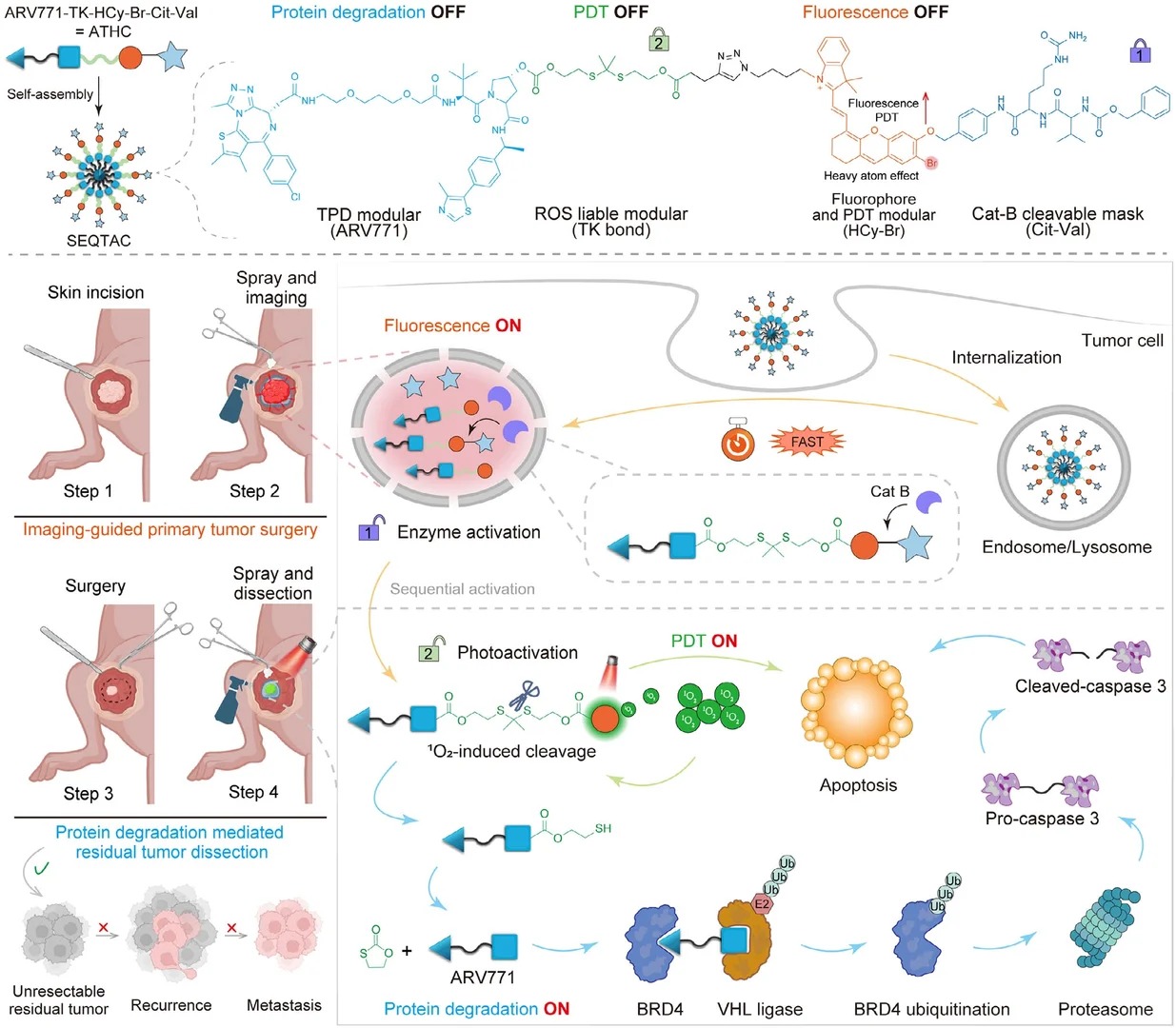
(3) Research Highlights: In this work, sequentially responsive theranostic chimeric SEQTAC nanoparticles were designed. Cysteine cathepsin B-activatable fluorophores were covalently conjugated with BRD4-PROTAC modified by singlet oxygen-sensitive linkages. The nanoparticles can be administered via local spraying. Through sequential enzyme-photo activation, their performance in intraoperative fluorescence imaging-guided navigation and postoperative residual tumor intervention was investigated at the cellular level and in animal models of breast cancer and glioblastoma.
(4) Innovations: ① A sequentially activated SEQTAC nanotheranostic system was constructed. The nanoparticles are formed via molecular self-assembly without additional carriers; ② A two-step cascade response is realized: cathepsin B triggers fluorescence turn-on for intraoperative tumor boundary identification, and near-infrared light generates singlet oxygen to cleave the linkage and release PROTAC; ③ Local spray administration at the surgical site is adopted to circumvent pharmacokinetic timing challenges caused by systemic administration; ④ Photodynamic therapy synergizes with BRD4 protein degradation to exert therapeutic intervention against postoperative residual tumors.
(5) Material Development
(1) Materials: The ATHC molecule was constructed using HCy-Br hemicyanine fluorophore-photosensitizer, TK thioketal bond, BRD4-targeted PROTAC (ARV771), and cathepsin B-cleavable Cit-Val peptide. SEQTAC nanoparticles were obtained via self-assembly.
(2) Functions: Fluorescence is restored in response to cathepsin B to enable intraoperative tumor tracing; irradiation at 655 nm generates singlet oxygen, which yields photodynamic effects and cleaves TK bonds to release PROTAC; BRD4 target protein degradation is achieved to induce tumor cell apoptosis; the formulation is compatible with local spray administration and possesses tumor tissue penetration capacity.
(6) Outlook: Probes can be remodeled by screening biomarkers with superior tumor specificity to reduce signal interference from inflammatory cells; the molecular structure can be further optimized to improve photoresponse kinetics; this sequential activation strategy can be expanded to accommodate more PROTACs and bioactive molecules.
We provide full-process services for custom material design, including innovative scheme design, fabrication, characterization, and in vitro & in vivo validation (cell and animal studies). Our postdoctoral team with multiple high-impact Q1 publications can tackle your challenging research demands. Our scope covers hydrogels, drug delivery systems, nanomaterials, polymers, liposomes, microneedles and more. We support project design, NSFC proposal writing, and high-quality SCI manuscripts for journals such as AFM, AM and other Q1/Q2 journals. Enquiries are welcome👇
17768014569 (Dr.Gao)
17761925168 (Dr. Zhang)
18013729810 (Dr. Yang)
18915694570
Previous: Custom Nanomaterial Se
Next: Custom‑Tailored


