

Custom Nanomaterial Service | Hypoxic AD Microenvironment: A New Breakthrough in Hydrogel Models
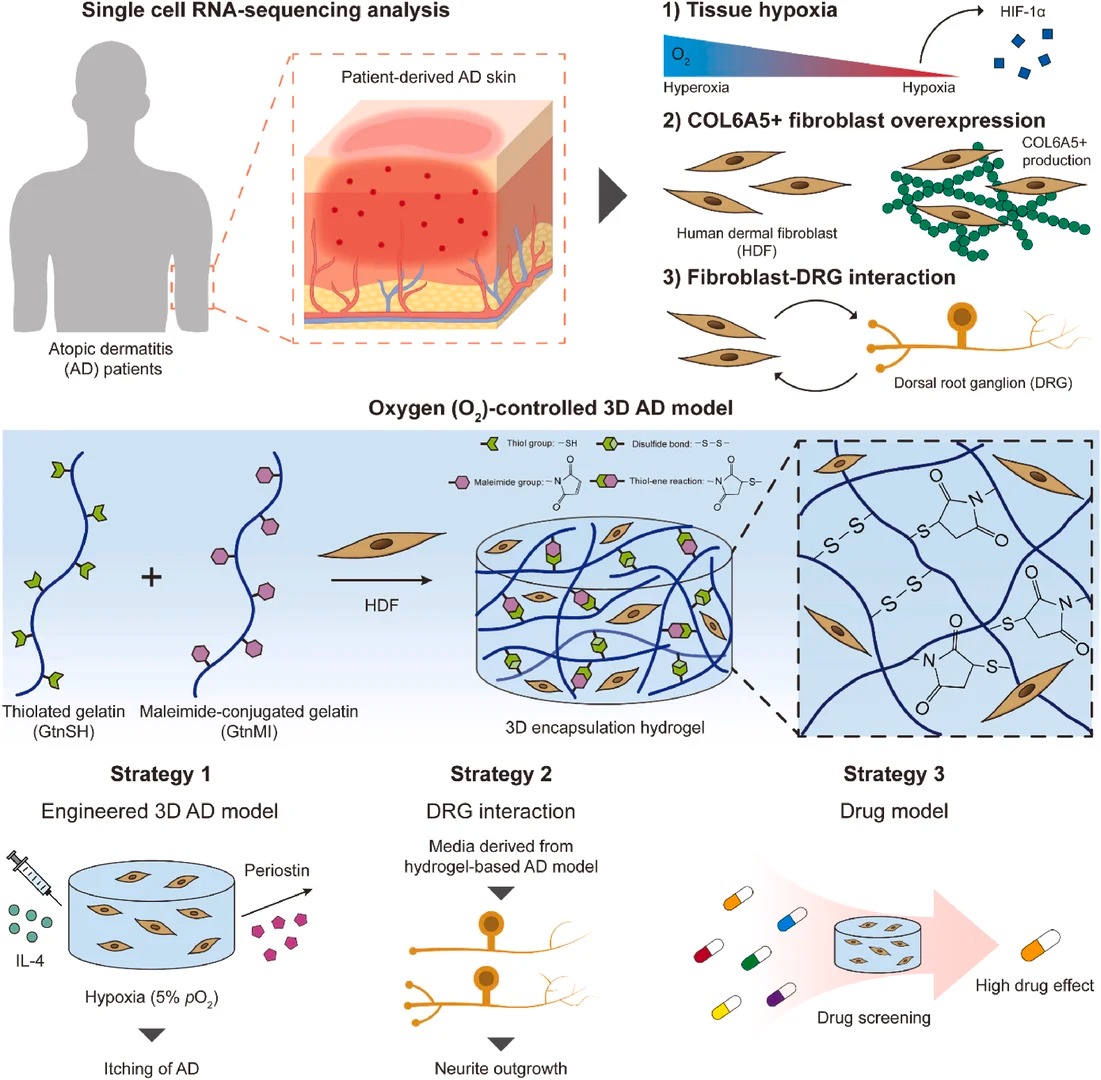 (1) Title Engineered Atopic Dermatitis Models: Recreating Hypoxic Conditions in the AD Microenvironment
(2) Research Highlights This work designs an in-situ crosslinkable gelatin-based hydrogel model. Single-cell RNA sequencing analysis was used to verify key features of AD tissues (including COL6A5+ fibroblast expression, itch-associated neural interactions and overexpression of hypoxia factors). On this basis, a 3D culture system that mimics the hypoxic microenvironment of AD was established. By regulating oxygen concentration and IL-4 stimulation, this model successfully recapitulates chronic hypoxia, immune responses and the expression of itch mediators in AD, offering a new platform for AD mechanistic research and drug screening.
(3) Innovations ① Targeting hypoxia mechanisms: For the first time, core features of the hypoxic microenvironment in AD tissues (e.g., hypoxic conditions with pO₂ < 5%) are integrated into hydrogel models; ② Multidimensional simulation: Combined with cellular interactions, immune stimulation (IL-4) and hypoxic conditions, it simultaneously recapitulates itch, inflammation and the pathological microenvironment of AD; ③ Dynamic responsiveness: The model enables real-time monitoring of gene expression (e.g., hypoxia-related genes) and the effects of drug intervention, supporting in-depth mechanistic exploration.
(4) Biomedical Applications of the Material Disease modeling: Serving as an in vitro platform mimicking the pathological microenvironment of AD to replace animal models for investigating hypoxia, immunity and neural interaction mechanisms; Drug development: Applied in high-throughput screening of candidate drugs targeting itch mediators (e.g., neuromediators) or hypoxia pathways (e.g., HIF-1α); Basic research: Elucidating the roles of the fibroblast–immune cell–neuron network in AD to facilitate the design of precision therapeutic strategies.
(5) Extended Research Directions ① Multicellular co-culture: Introducing embedded co-culture systems of keratinocytes and immune cells to simulate the dynamics at the epidermal–dermal interface in AD; ② Microfluidic integration: Combining chip technology to achieve oxygen gradient control and cell migration analysis for improved microenvironment authenticity; ③ Cross-disease expansion: Adapting the system to develop models for other hypoxia-associated skin disorders (such as psoriasis) or chronic wounds.
We provide full-process services for custom material design, including innovative scheme design, fabrication, characterization, and in vitro & in vivo validation (cell and animal studies). Our postdoctoral team with multiple high-impact Q1 publications can tackle your challenging research demands. Our scope covers hydrogels, drug delivery systems, nanomaterials, polymers, liposomes, microneedles and more. We support project design, NSFC proposal writing, and high-quality SCI manuscripts for journals such as AFM, AM and other Q1/Q2 journals. Enquiries are welcome👇
17768014569 (Dr.Gao)
17761925168 (Dr. Zhang)
18013729810 (Dr. Yang)
18915694570
Previous: Daily Retina Idea: Inh
Next: Custom Nanomaterial Se


