

Daily Retina Idea: Inherited Retinal Degenerations
(1) Abstract: This review focuses on inherited retinal degenerations, summarizing clinical phenotypes, disease categories based on affected retinal cell types, and emerging therapeutic strategies. It emphasizes genetic testing, early recognition, and multidisciplinary management, and discusses gene-, cell-, optogenetic-, and implant-based approaches.
(2) Background: Inherited retinal degenerations are a molecularly heterogeneous group of neurodegenerative disorders that primarily affect photoreceptors and retinal pigment epithelial cells, causing progressive vision loss. Inheritance patterns are diverse, and phenotypes are influenced by genetic variants, modifier factors, and environmental factors, making clinical recognition and precise classification challenging.
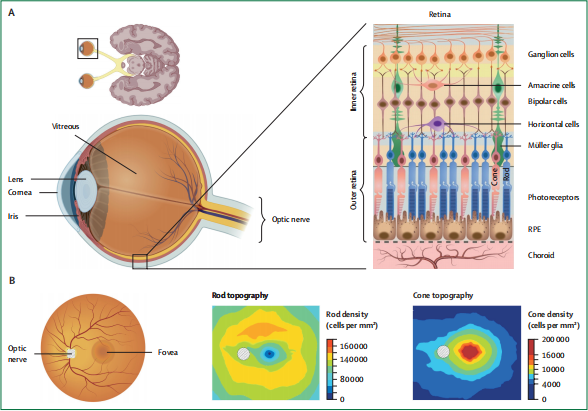
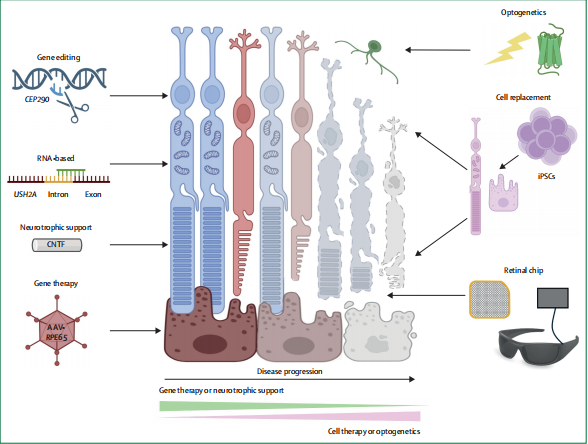
(3) Main Content: The review categorizes phenotypes by primary affected cell type, including rod-predominant, cone- and central retina-predominant, retinal pigment epithelium-predominant, and other forms. It discusses retinal anatomy, photoreceptor structure, and connecting cilium-related mechanisms, and summarizes gene augmentation, gene editing, RNA-based intervention, neuroprotection, cell replacement, optogenetics, and retinal implants.
(4) Study Design: This is a narrative review. PubMed was searched using terms including inherited retinal degeneration, retinitis pigmentosa, rod-cone dystrophy, cone-rod dystrophy, retinal dystrophy, and retinopathy. Recent literature was prioritized, and landmark studies were cited based on author expertise.
(5) Results: The review indicates that different affected cell types correspond to distinct symptoms and examination features. Genetic testing improves molecular diagnosis, but deep intronic and structural variants may be missed, requiring exome or genome sequencing and genetic counseling when indicated. Therapeutically, gene augmentation applies to some monogenic diseases, while gene editing and RNA-based approaches broaden mutation coverage; neuroprotection, cell replacement, optogenetics, and implants target different disease stages and cell types.
(6) Future Directions: Future work should emphasize early recognition, standardized genetic testing, and multidisciplinary care, and refine structural, functional, and patient-reported outcome measures. Natural history studies and biomarkers may aid trial design. The appropriate disease stage, target cells, delivery methods, and long-term evaluation of different therapeutic strategies require systematic investigation.
We provide full-process services for various material designs (including highly innovative scheme design, preparation, characterization, in vitro and in vivo validation (cell/animal experiments), etc.): a postdoctoral team (with multiple high-impact publications in Zone 1 journals) can meet all kinds of tricky and challenging requirements, including hydrogels / drug delivery / nanomaterials / polymers / liposomes / microneedle drug delivery, etc. We can assist with project design / NSFC grant applications / publication of high-impact Zone 1 and Zone 2 papers in journals such as AFM, SCI, AM, etc. Welcome to consult 👇️
17768014569 (Senior Engineer Gao)
17761925168 (Engineer Zhang)
18013729810 (Engineer Yang)
18915694570
Previous: Nanomaterial Customiza
Next: Custom Nanomaterial Se


