
Custom Nanomaterial Service | pH-Responsive Switchable Antibacterial, Anti-Inflammatory Smart Hydrogel for Wound Healing published in *Bioactive Materials*
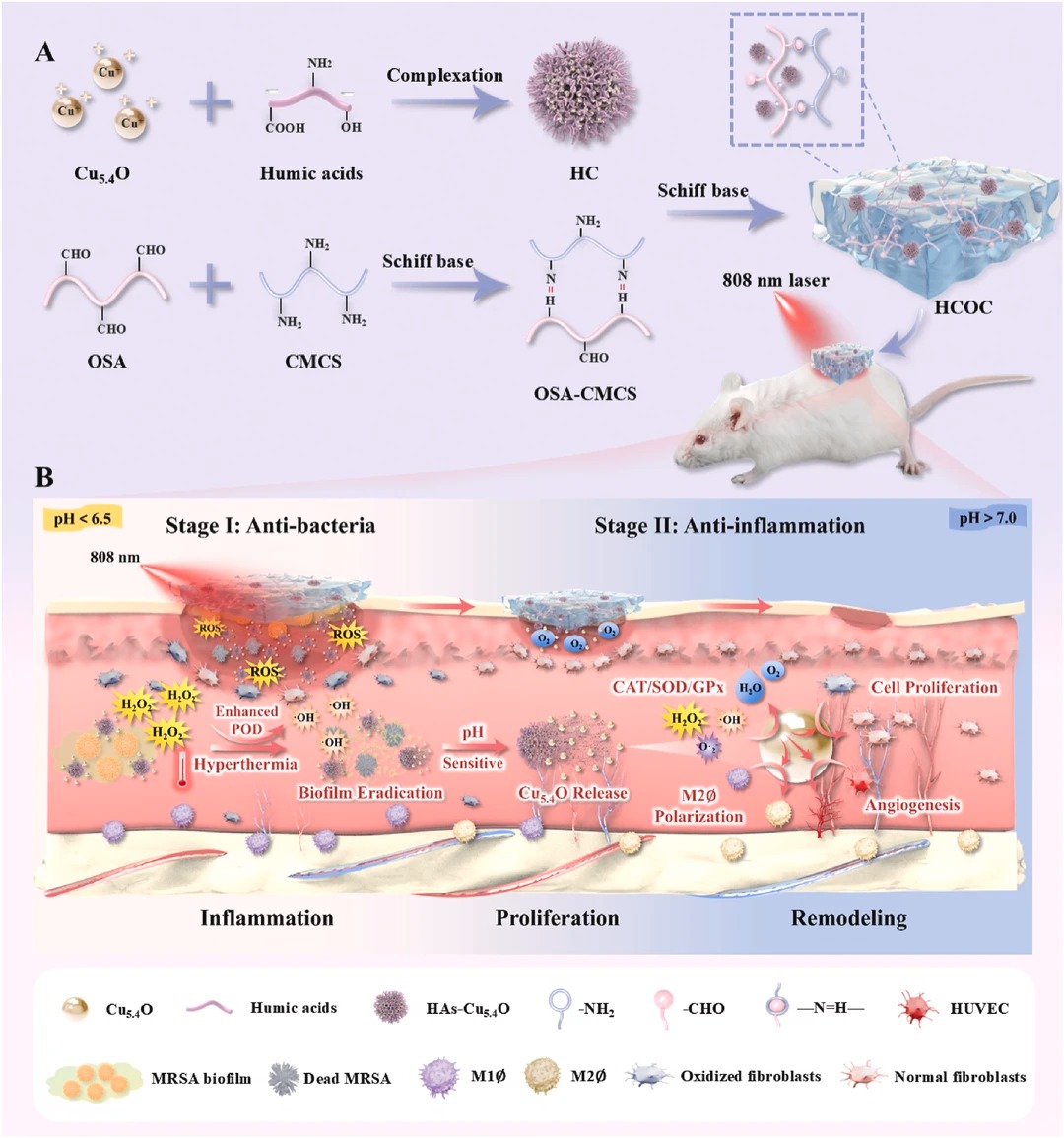 💡 Research Idea To achieve programmable, microenvironment-adaptive therapy for biofilm-infected wounds, the research team designed an intelligent hydrogel dressing (HCOC). The core strategy is as follows: humic acid-encapsulated ultrasmall mixed-valence copper nanozymes (Cu₅.₄O) are integrated into an oxidized alginate‑carboxymethyl chitosan network. Taking advantage of the aggregation behavior of humic acid under acidic conditions and its solubility under near-neutral conditions, a "pH-responsive switch" is realized — synergistic high-efficiency bactericidal activity via chemodynamic therapy/photothermal therapy at the early stage, followed by a shift to an antioxidant mode to facilitate tissue repair at the later stage.
⚡ Innovation Intelligent switching of pH-responsive therapeutic modes: In the acidic microenvironment of biofilm infection (pH < 6.5), the humic acid shell aggregates to controllably release Cu₅.₄O, which initiates chemodynamic therapy to generate reactive oxygen species. Meanwhile, humic acid itself mediates photothermal therapy. The two approaches work synergistically to achieve efficient bactericidal effect (99.99%) and biofilm disruption (87.46%). After infection is controlled and the wound pH rises to neutral (pH ≥ 7.0), humic acid dissolves and releases more nanozymes. The enzymatic activity switches to an antioxidant mode (scavenging over 90% of reactive oxygen species). By inhibiting the NF‑κB pathway and activating the Wnt/β‑catenin pathway, the nanozymes promote macrophage polarization toward the M2 phenotype, driving anti-inflammation and tissue regeneration.
🌟 Research Outcomes Efficient bactericidal activity and biofilm elimination: In vitro, the killing rate against MRSA and Escherichia coli reaches 99.99%, and the biofilm disruption rate is 87.46%. Accelerated healing of infected wounds: In animal models, the wound closure rate reaches 91.65% after 7 days of HCOC treatment combined with near-infrared irradiation, with markedly enhanced angiogenesis (approximately 90 CD31⁺ cells per field of view) and M2 macrophage infiltration (approximately 110 CD163⁺ cells per field of view). Well-defined mechanism: The study verifies the pH-responsive therapeutic mode switch and the sequential synergistic mechanism of antibacterial, anti-inflammatory and pro-regenerative effects.
📚 Source Bioactive Materials
#Nanomaterials #ScientificResearch #MedicineEngineeringInterdiscipline #ResearchStudy #Hydrogel #Regeneration #BiomedicalResearch
We provide full-process services for custom material design, including innovative scheme design, fabrication, characterization, and in vitro & in vivo validation (cell and animal studies). Our postdoctoral team with multiple high-impact Q1 publications can tackle your challenging research demands. Our scope covers hydrogels, drug delivery systems, nanomaterials, polymers, liposomes, microneedles and more. We support project design, NSFC proposal writing, and high-quality SCI manuscripts for journals such as AFM, AM and other Q1/Q2 journals. Enquiries are welcome👇
17768014569 (Dr.Gao)
17761925168 (Dr. Zhang)
18013729810 (Dr. Yang)
18915694570
Previous: Daily Ligament Regener
Next: Daily Ophthalmology Re


