
Daily Ligament Regeneration Idea | Multilevel Helical Bacterial Cellulose Scaffold for Ligament Reconstruction
(1) Journal Source
Science Bulletin (2026, online pre-proof/Article in Press).
(2) Title
Multilevel helical bacterial cellulose scaffold for ligament reconstruction.
(3) Research Approach
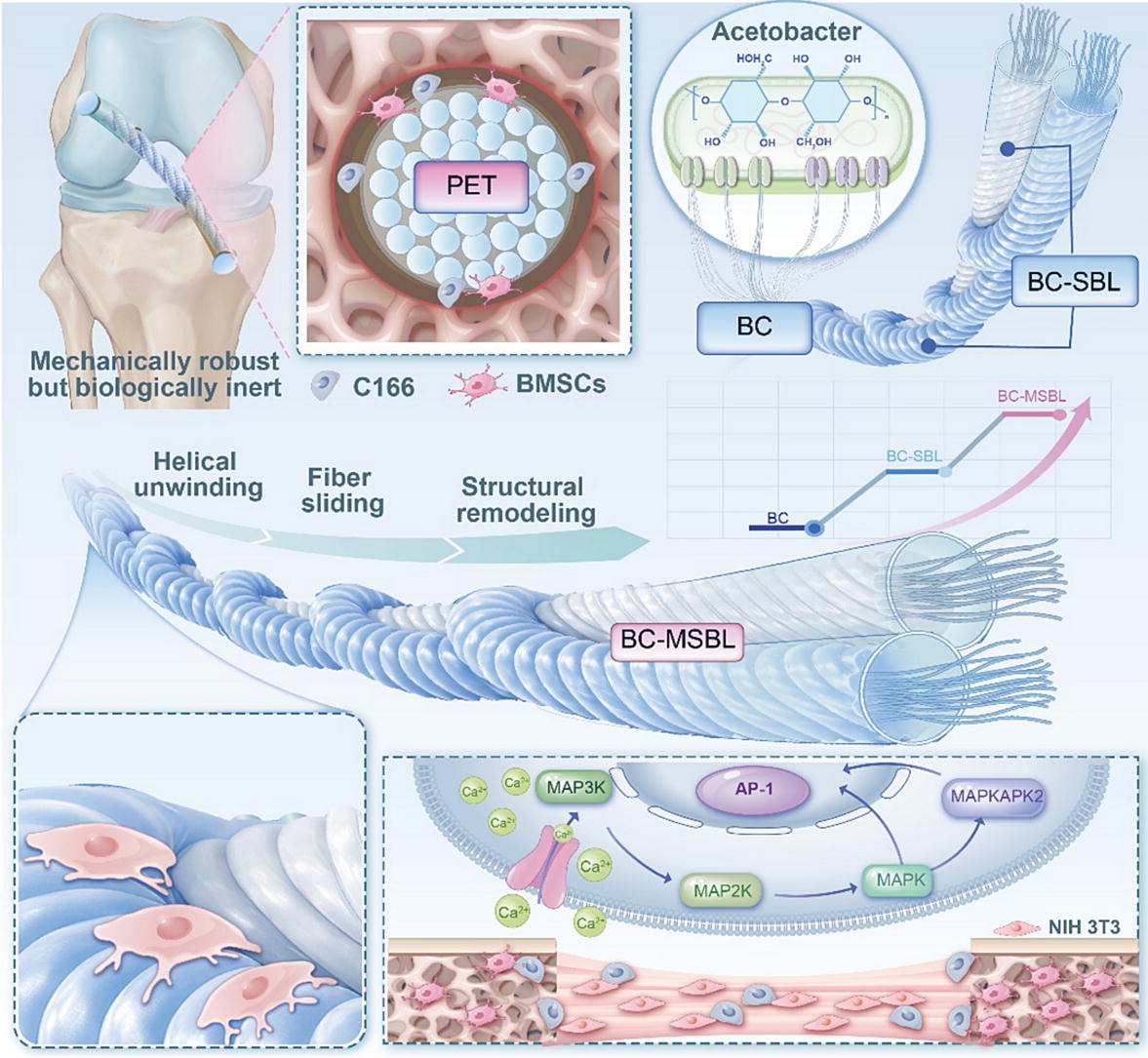
Inspired by the hierarchical helical structure of the native anterior cruciate ligament, bacterial cellulose nanofiber networks were pre-stretched and twisted into single-level helical bundles, then assembled into a core–sheath multilevel helical scaffold. Mechanical testing, finite element simulation, and fatigue testing were used to analyze how the helical architecture contributes to strength, toughness, and energy dissipation. In vitro, bone marrow mesenchymal stem cells were used to evaluate adhesion, transcriptomic changes, Piezo1–Ca²⁺–MAPK/AP-1 mechanotransduction, and osteogenic differentiation, and conditioned media were analyzed for paracrine effects on fibroblasts and endothelial cells. In vivo, a rat anterior cruciate ligament reconstruction model was used to evaluate bone–ligament integration, bone tunnel changes, pull-out mechanics, histology, and gait recovery.
(4) Innovation
A single bacterial cellulose material achieves coordinated mechanical support and bioactivity. The core–sheath multilevel helical structure enables progressive uncoiling and fiber sliding for stable energy dissipation. Anisotropic microgrooves act as topographical cues to activate Piezo1-related mechanotransduction and coordinate osteogenesis, vascularization, and matrix remodeling. The design relies on structural encoding rather than exogenous cells or growth factors to directly regulate cell behavior.
(5) Material Development
Bacterial cellulose was obtained by static culture and purification, prepared into strips, pre-stretched and twisted, optimized for twist density, and further core–sheath wound to construct the multilevel helical scaffold. Thermal stability, chemical composition, surface morphology, roughness, tensile properties, fatigue behavior, and stress distribution were characterized, together with cytocompatibility, osteogenic responses, and paracrine effects.
We provide full-process services for various material designs (including highly innovative scheme design, preparation, characterization, in vitro and in vivo validation (cell/animal experiments), etc.): a postdoctoral team (with multiple high-impact publications in Zone 1 journals) can meet all kinds of tricky and challenging requirements, including hydrogels / drug delivery / nanomaterials / polymers / liposomes / microneedle drug delivery, etc. We can assist with project design / NSFC grant applications / publication of high-impact Zone 1 and Zone 2 papers in journals such as AFM, SCI, AM, etc. Welcome to consult 👇️
17768014569 (Senior Engineer Gao)
17761925168 (Engineer Zhang)
18013729810 (Engineer Yang)
#AnteriorCruciateLigament #BacterialCellulose #MultilevelHelicalScaffold #Piezo1 #Mechanotransduction #NanomaterialCustomization #ResearchServices #SciTalk #ResearchMaterials #BKNano
18915694570
Previous: Daily Ocular Materials
Next: Daily Ophthalmology Re


