
Daily Ophthalmology Research Idea | Presbyopia-Correcting IOLs: Optics and Patient-Reported Outcomes
(1) Journal Source
Progress in Retinal and Eye Research (2026).
(2) Title
Presbyopia-correcting intraocular lenses: optical classification and patient-reported outcomes.
(3) Research Approach
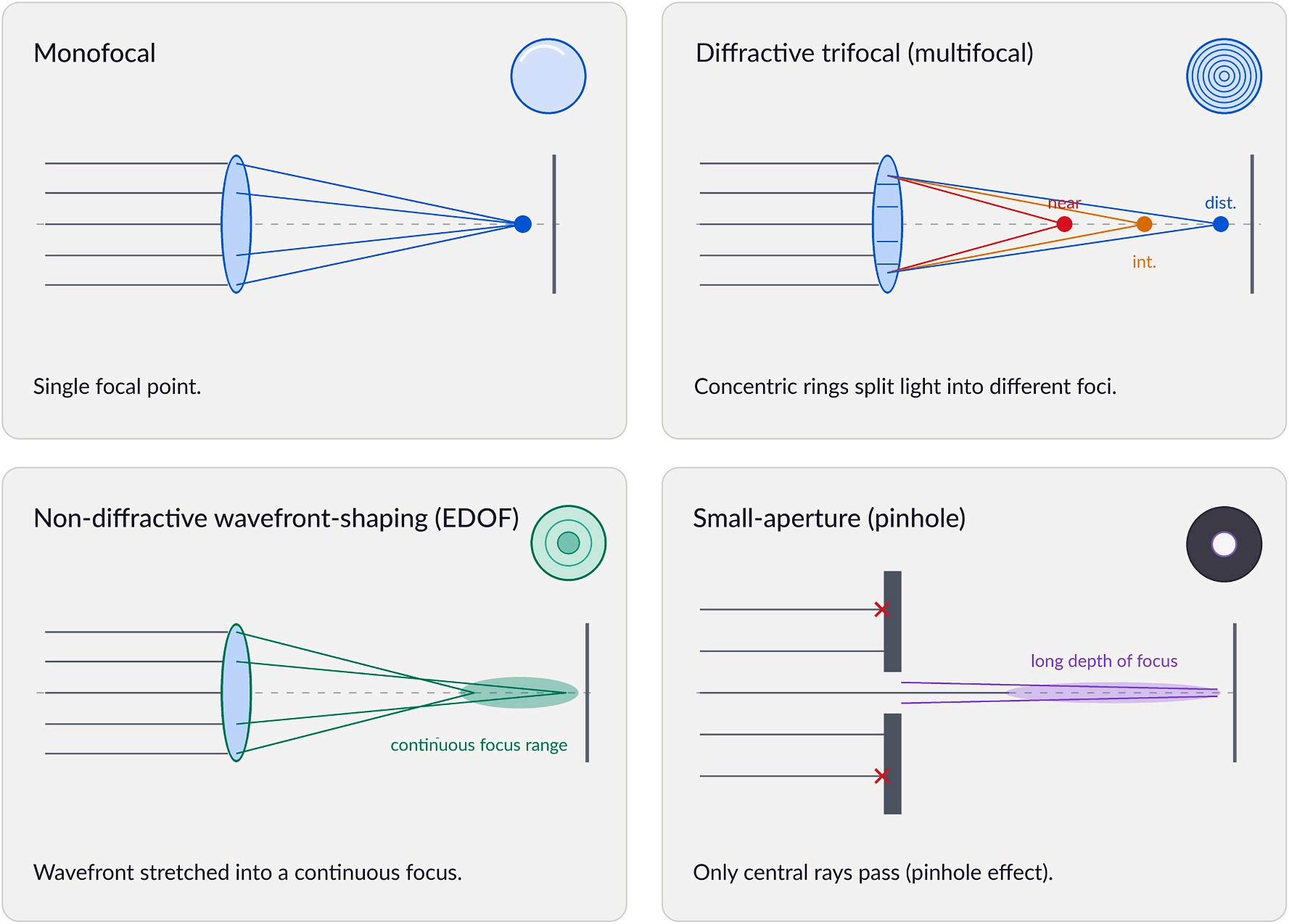
Starting from the mechanisms of presbyopia and intraocular lens optics, this review outlines simultaneous-vision designs including multifocal, extended depth of focus (EDOF), and full visual range (FVR), and explains the trade-offs among diffraction, non-diffractive wavefront shaping, and small-aperture strategies in terms of range of vision, contrast sensitivity, and halos. It then focuses on patient-reported outcome measures (PROMs) for capturing subjective visual experience, neuroadaptation, and satisfaction, and analyzes why their correlations with visual acuity and contrast sensitivity are limited.
(4) Innovation
The review links intraocular lens classification with ISO 11979-7:2024 and emphasizes that EDOF and FVR are defined by performance rather than a single optical mechanism. It highlights PROMs as a key dimension reflecting patient experience and satisfaction, notes that identical postoperative visual acuity can still be associated with markedly different subjective outcomes, and proposes that lens selection should consider patients’ visual priorities, expectations, and neuroadaptive capacity rather than objective acuity alone.
(5) Material Development
This is a review; no new materials, nanomaterials, or delivery systems were developed or characterized. The discussion concerns intraocular lens optical designs, material platforms, and patient-reported assessment tools, without material synthesis, carrier construction, or material-performance evaluation.
We provide full-process services for various material designs (including highly innovative scheme design, preparation, characterization, in vitro and in vivo validation (cell/animal experiments), etc.): a postdoctoral team (with multiple high-impact publications in Zone 1 journals) can meet all kinds of tricky and challenging requirements, including hydrogels / drug delivery / nanomaterials / polymers / liposomes / microneedle drug delivery, etc. We can assist with project design / NSFC grant applications / publication of high-impact Zone 1 and Zone 2 papers in journals such as AFM, SCI, AM, etc. Welcome to consult 👇️
17768014569 (Senior Engineer Gao)
17761925168 (Engineer Zhang)
18013729810 (Engineer Yang)
#PresbyopiaCorrection #IntraocularLens #PatientReportedOutcomes #MultifocalIOL #EDOF #NanomaterialCustomization #ResearchServices #SciTalk #ResearchMaterials #BKNano
18915694570
Previous: Custom Nanomaterial Se
Next: Daily Ophthalmology Re


