
Custom Nanomaterial Service | Cancer Stem Cells Coordinate Immune Evasion via Extracellular Vesicle-Mediated Noncanonical Signaling Pathways
 1. Title: Cancer Stem Cells Orchestrate Immune Evasion via Extracellular Vesicle-Mediated Noncanonical Signaling Pathway
Journal: Cancer Cell
Publication Date: May 7, 2026
DOI: 10.1016/j.ccell.2026.04.004
One-sentence Conclusion: TSPAN8⁺ cancer stem cells expand Tregs via vesicle surface signals, forming an immune evasion axis targetable by combination therapy.
2. Research Background
Triple-negative breast cancer is highly aggressive and lacks canonical therapeutic targets, and immunotherapy only benefits a subset of patients. How cancer stem cells induce Tregs remains unclear.
Methods
The study analyzed 65 treatment-naive TNBC samples, combined with single-cell proteomics and transcriptomics, multiplex immunohistochemistry, vesicle isolation, proteomic profiling, RNA sequencing, cellular assays and mouse experiments.
3. Research Content and Interpretation of Key Figures
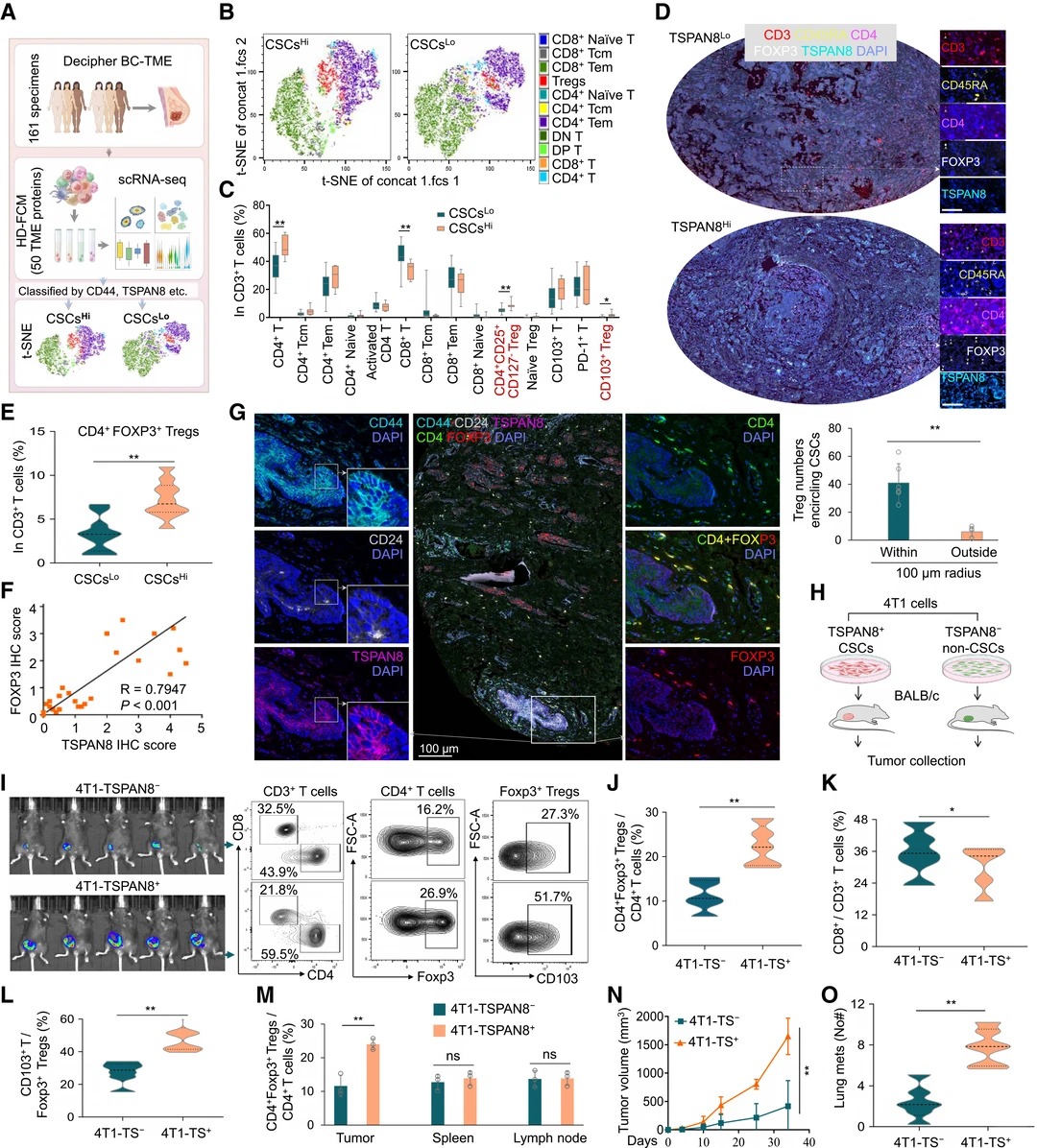
Figure 1–3: Tumors with abundant CSCs exhibit increased Tregs and decreased CD8⁺ T cells; TSPAN8⁺ vesicles promote Treg differentiation and proliferation.
Figure 4–6: This effect is independent of intravesicular cargo. TSPAN8 binds CD103 and activates the MAP4K4-LKB1-AMPK-FOXP3 positive feedback loop.
Figure 7–8: CD103⁺FOXP3⁺ Tregs and plasma TSPAN8⁺ vesicles are associated with poor prognosis. Anti-TSPAN8 combined with anti-PD-1 suppresses tumor growth and lung metastasis in mice. Among 28 patients receiving neoadjuvant therapy, the pathological complete response rate was 14% in the high-CSC group and 51% in the low-CSC group.
4. Overall Conclusion
Cancer stem cells can reprogram T cells using vesicle membrane proteins. TSPAN8 may serve as a biomarker for immune resistance and a therapeutic target, though only preclinical evidence is available to date.
5. Limitations and Future Perspectives
The neoadjuvant cohort included only 28 patients, and vesicle heterogeneity as well as limitations of cellular and mouse models restrict the generalizability of the findings. Future multicenter validation is required, and the safety and eligible patient population for anti-TSPAN8 therapy need to be evaluated.
We provide full-process services for custom material design, including innovative scheme design, fabrication, characterization, and in vitro & in vivo validation (cell and animal studies). Our postdoctoral team with multiple high-impact Q1 publications can tackle your challenging research demands. Our scope covers hydrogels, drug delivery systems, nanomaterials, polymers, liposomes, microneedles and more. We support project design, NSFC proposal writing, and high-quality SCI manuscripts for journals such as AFM, AM and other Q1/Q2 journals. Enquiries are welcome👇
17768014569 (Dr.Gao)
17761925168 (Dr. Zhang)
18013729810 (Dr. Yang)
18915694570
Previous: Custom Nanomaterial Se
Next: Daily Ophthalmology Re


