
Customized Nanomaterial Service | Peptide Nanoengineering for Oral Infections in *ACS Nano*
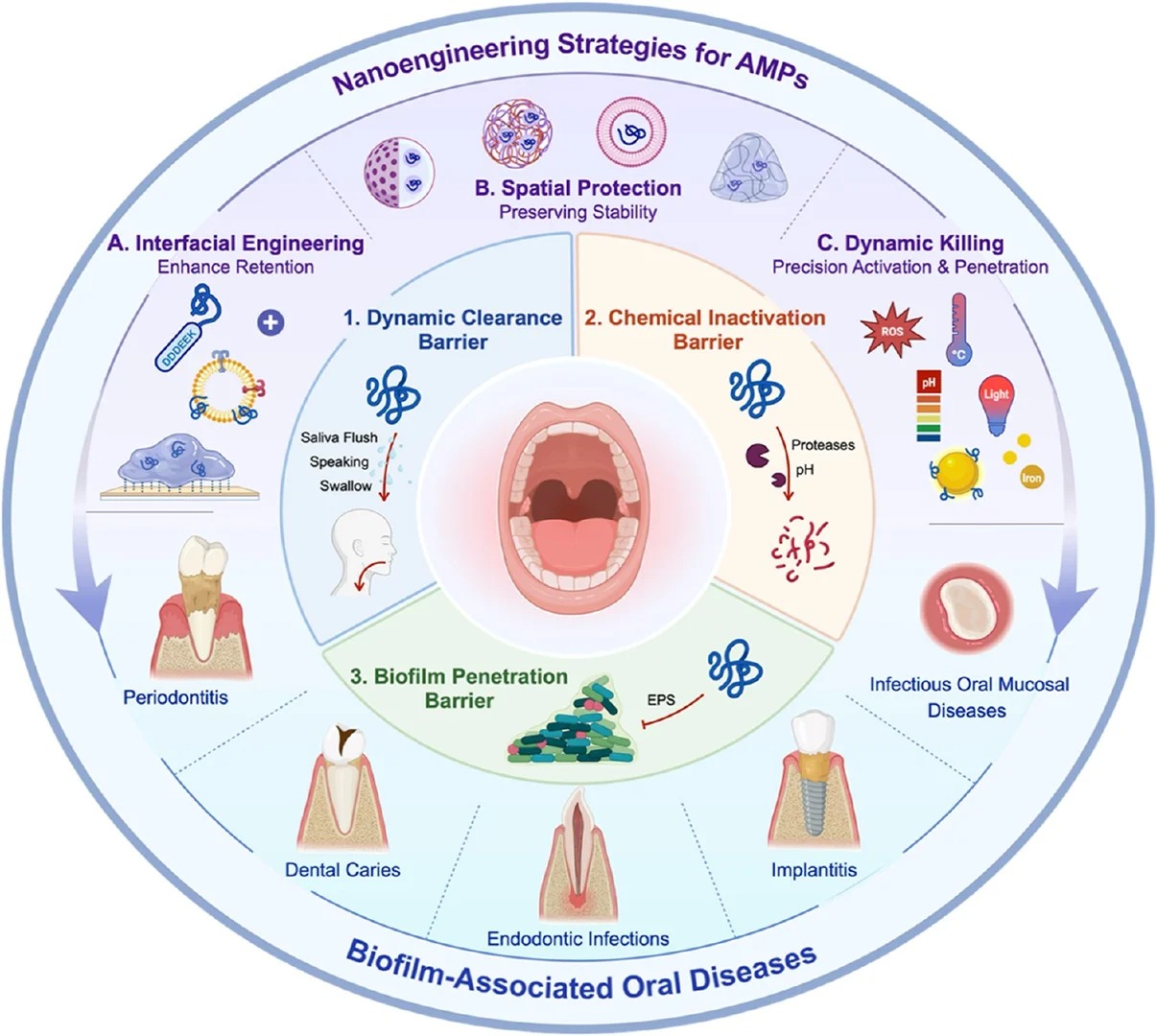
Biofilm-associated oral diseases pose severe threats. Antimicrobial peptides (AMPs) represent promising alternatives to antibiotics. Nevertheless, free peptides are readily cleared and inactivated owing to three major obstacles in the oral cavity: salivary washout, protease degradation and biofilm barriers. Most existing delivery systems focus merely on bactericidal effects, lacking integrated nanoengineering strategies adapted to diverse pathological scenarios in the oral cavity, which leaves numerous bottlenecks for clinical translation.
This work establishes a nanoengineering strategy framework tailored to multiple oral barriers. It comprises three modules: interface engineering for improved local retention, spatial protection to maintain peptide stability, and microenvironment responsiveness for on-demand activation. The framework integrates antibacterial, immunomodulatory and tissue-repairing functions. It systematically compares the advantages and limitations of diverse carriers and analyzes translational challenges including biosafety, microbial homeostasis and scalable production.
Several nanoengineering approaches are summarized:
① Interface engineering: electrostatic/covalent adhesion, specific targeting and adhesive hydrogels to prolong retention at oral lesion sites;
② Spatial protection: peptide self-assembly, encapsulation within nanocarriers and covalent spatial shielding to resist protease degradation;
③ Microenvironment responsiveness: pH/enzyme/ROS-triggered release, combined with nanomaterials to disrupt EPS biofilms.
In vitro evaluations of peptide stability and antibiofilm performance are performed, and therapeutic efficacy is validated using multiple animal models of oral diseases.
This nano-peptide delivery logic of “overcoming physiological barriers – carrier modification – microenvironment responsiveness – multifunctional synergy” can be transferred to mucosal infectious diseases of the skin, respiratory tract and other sites. The core lies in dissecting physiological barriers of target tissues and rationally designing retention-protection-response modules. Priority is given to the phenotype of **effective action at pathological sites with minimal disturbance to normal mucosa**, while preserving the homeostasis of host commensal microbiota. This concept can highlight translational feasibility in grant applications and avoid redundant stacking of unnecessary complicated functions.
We provide full-process services for custom material design, including innovative scheme design, fabrication, characterization, and in vitro & in vivo validation (cell and animal studies). Our postdoctoral team with multiple high-impact Q1 publications can tackle your challenging research demands. Our scope covers hydrogels, drug delivery systems, nanomaterials, polymers, liposomes, microneedles and more. We support project design, NSFC proposal writing, and high-quality SCI manuscripts for journals such as AFM, AM and other Q1/Q2 journals. Enquiries are welcome
17768014569 (Dr.Gao)
17761925168 (Dr. Zhang)
18013729810 (Dr. Yang)
18915694570
Previous: Custom Nanomaterial Se
Next: Daily Ophthalmology Re


