
Custom Nanomaterial Service | Nanocarriers in *Bioactive Materials* Enable Immune Remodeling of Cold Tumors
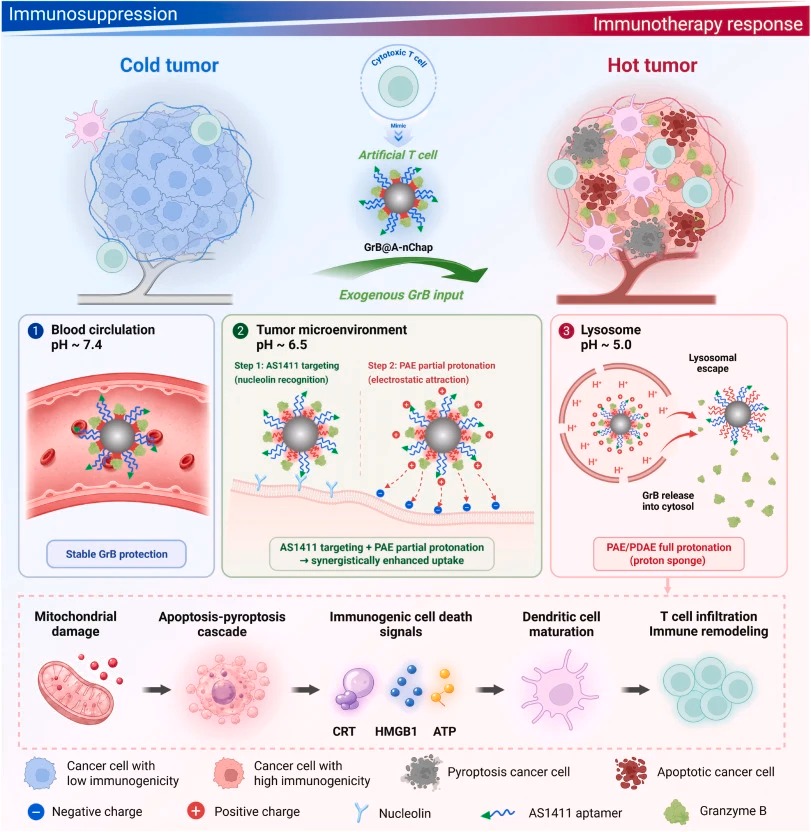 🚇Research Background: In cold tumors, T cells cannot infiltrate the tumor microenvironment, and even those that enter fail to exert effector functions, rendering immune checkpoint blockade largely ineffective. The innate immune mechanism relies on CTLs to release granzyme B into the cytoplasm of target cells to initiate the death cascade. However, naked proteins have an extremely short half-life and cannot reach deep tumor regions. Targeted nanocarriers are adopted to deliver granzyme B, this key effector molecule, intact into the cytoplasm of tumor cells, replenishing the deficient cytotoxic function in cold tumors and addressing the unavoidable bottleneck restricting immune responses in cold tumors.
🚇Research Strategy: The team centered the targeting design on AS1411-mediated targeting with dual-pH responsiveness. The carrier surface was modified with the AS1411 aptamer to achieve nucleolin-mediated cellular uptake. The dual-pH-responsive moiety achieves sequential protonation by leveraging the pKa difference between the weak acidic tumor microenvironment and the strongly acidic lysosomes. The carrier stabilizes and protects granzyme B during circulation in the bloodstream. After reaching the tumor site, surface charge reversal enhances cellular uptake, and the proton sponge effect within lysosomes releases GrB into the cytoplasm. GrB triggers mitochondrial dysfunction and the caspase-3/GSDME apoptosis-pyroptosis cascade, releasing ICD signals to promote DC maturation and T cell infiltration. Combined with PD-1 blockade, this strategy achieves potent tumor control.
🚇Critical Literature Commentary: The most ingenious highlight of this work is engineering the delivery system itself as a programmable switch. While most carrier designs only focus on loading and release, this team employed the AS1411 aptamer for targeted recognition and dual-pH-responsive segments for sequential release, precisely regulating every step of granzyme B from injection, cellular internalization to functional activation. It is notable that cytoplasmic GrB simultaneously activates two cell death pathways: apoptosis and pyroptosis. The ICD signals can retroactively activate local immune responses, and the combination with PD-1 blockade converts cold tumors into hot tumors. Nevertheless, the batch-to-batch consistency of large-scale nanocarrier fabrication, long-term biosafety, and pathways for clinical translation still require further validation.
🚇Title: Cytotoxic T lymphocyte-inspired nanotherapeutics chaperoning granzyme B for tumor immune remodeling
🚇Source: Bioactive Materials
#ResearchDaily #LiteratureShare #Nanomaterials #Biomaterials #TumorImmunology #Nanocarrier #MaterialsScience #PhDStudy #Academics #Researcher
We provide full-process services for custom material design, including innovative scheme design, fabrication, characterization, and in vitro & in vivo validation (cell and animal studies). Our postdoctoral team with multiple high-impact Q1 publications can tackle your challenging research demands. Our scope covers hydrogels, drug delivery systems, nanomaterials, polymers, liposomes, microneedles and more. We support project design, NSFC proposal writing, and high-quality SCI manuscripts for journals such as AFM, AM and other Q1/Q2 journals. Enquiries are welcome👇
17768014569 (Dr.Gao)
17761925168 (Dr. Zhang)
18013729810 (Dr. Yang)
18915694570
Previous: Daily Ocular Metabolis
Next: Daily Ophthalmology Re


