
Custom Nanomaterial Service | Photoresponsive Hydrogels in *Journal of Materials Science & Technology* for Spinal Cord Injury Repair
 (1) Journal Source: Journal of Materials Science & Technology
(2) Title: Development of a thermo‑responsive therapeutic hydrogel for spinal cord injury repair via modulating oxidative stress microenvironment and improving mitochondrial function
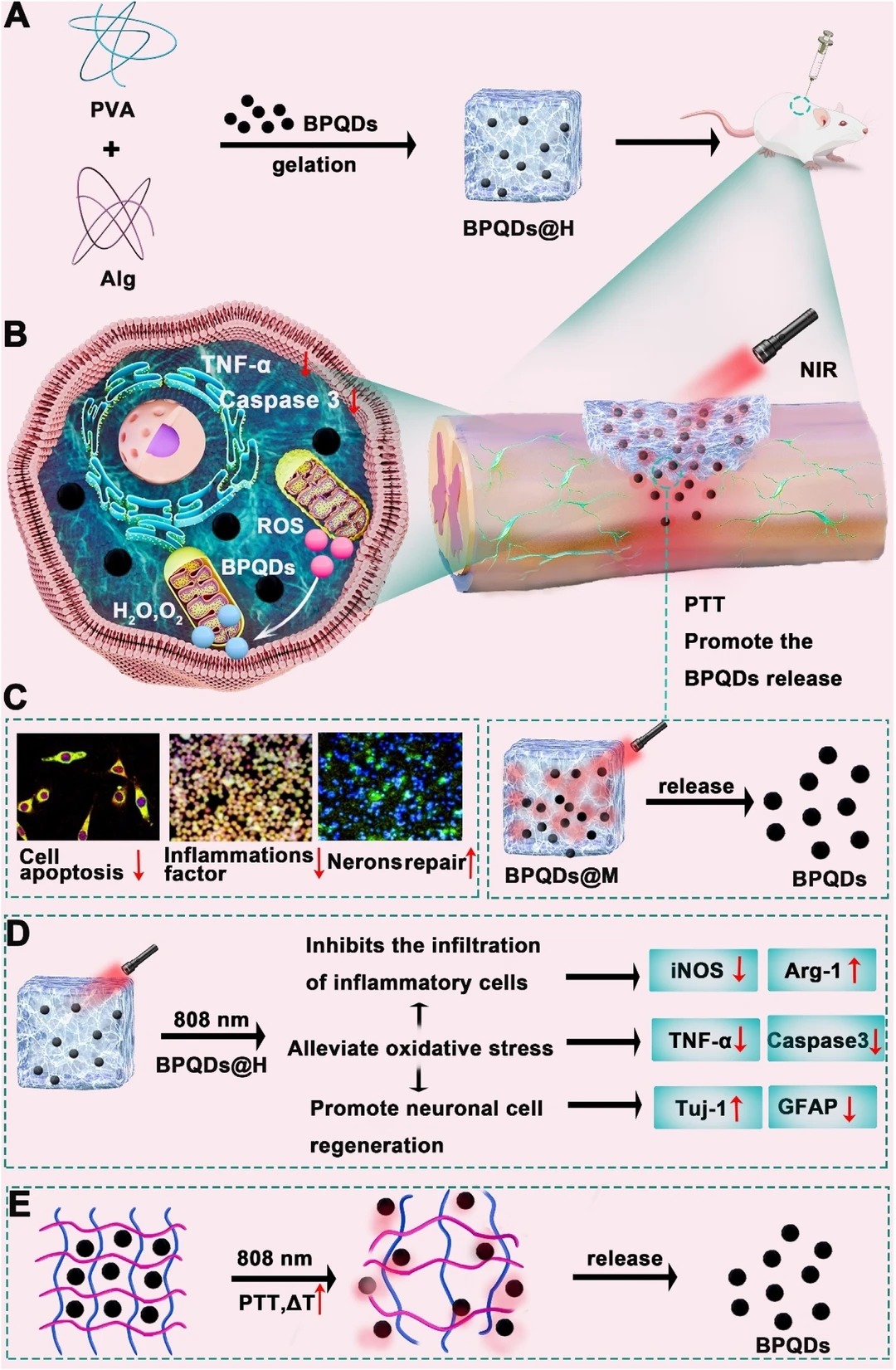
(3) Research Highlights: In this work, an injectable near-infrared-responsive BPQDs@H composite hydrogel was designed. Systematic physicochemical characterizations of the material were carried out. Combined with in vitro cell experiments and a mouse spinal cord injury model, the neuroprotective effect of this hydrogel by regulating the oxidative stress microenvironment and improving mitochondrial function was explored. The related molecular pathways of photothermally mediated material release, inflammation regulation and inhibition of glial scar formation were analyzed.
(4) Innovations: ① Black phosphorus quantum dots (BPQDs) were incorporated into PVA/sodium alginate hydrogel to construct an injectable composite hydrogel with near-infrared photothermal responsiveness; ② Near-infrared irradiation can trigger the photothermal effect of the hydrogel, simultaneously achieving local temperature elevation and controllable release of BPQDs, forming a synergistic mode of photothermal-promoted circulation-drug release-multi-target repair; ③ It was verified that the material can regulate microglial polarization, scavenge reactive oxygen species, protect mitochondria and inhibit neuronal apoptosis; ④ By downregulating the PI3K/AKT signaling pathway, the excessive proliferation of astrocytes is suppressed, glial scars are alleviated, and neuronal repair and motor function recovery are facilitated.
(5) Material Development: (1) Materials: Black phosphorus quantum dots (BPQDs) were prepared by exfoliation; using PVA and sodium alginate as the matrix, BPQDs were incorporated to obtain the injectable photothermal-responsive composite hydrogel BPQDs@H. (2) Functions: It features injectable molding and favorable mechanical properties; it exhibits near-infrared-responsive photothermal performance and enables controllable release of BPQDs; it scavenges reactive oxygen species, maintains mitochondrial homeostasis and inhibits neuronal apoptosis; it modulates microglial phenotypes, inhibits glial scar formation, improves the local injury microenvironment and protects nerve tissues.
(6) Extended Research Ideas: Secondary injury after spinal cord injury involves multiple pathological problems including oxidative stress, inflammation and glial scars. Photothermal nano-units can be incorporated into injectable hydrogels to realize controllable drug release at the lesion site via an external light source. Multiple pathological injuries can be synergistically intervened through multiple pathways by a single material, which provides a reference for the design of repair materials for central nervous system injury.
#Biomaterials #Hydrogel #SpinalCordInjury #BlackPhosphorusQuantumDots #ResearchPaperInterpretation #ScientificResearch
We provide full-process services for custom material design, including innovative scheme design, fabrication, characterization, and in vitro & in vivo validation (cell and animal studies). Our postdoctoral team with multiple high-impact Q1 publications can tackle your challenging research demands. Our scope covers hydrogels, drug delivery systems, nanomaterials, polymers, liposomes, microneedles and more. We support project design, NSFC proposal writing, and high-quality SCI manuscripts for journals such as AFM, AM and other Q1/Q2 journals. Enquiries are welcome👇
17768014569 (Dr.Gao)
17761925168 (Dr. Zhang)
18013729810 (Dr. Yang)
18915694570
Previous: Daily Bone Metabolism
Next: Daily Ophthalmology Re


