
Daily Bone Metabolism Idea | Estrogen–PDK4–MYH9 Axis Drives Mitochondrial Fission and Osteogenic Commitment
(1) Journal Source
Journal of Advanced Research (2026, accepted manuscript/pre-proof, DOI: 10.1016/j.jare.2026.10.051).
(2) Title
Original title: Estrogen-driven PDK4-MYH9 phosphorylation promotes mitochondrial fission and osteogenic commitment of mesenchymal stem cells.
(3) Research Approach
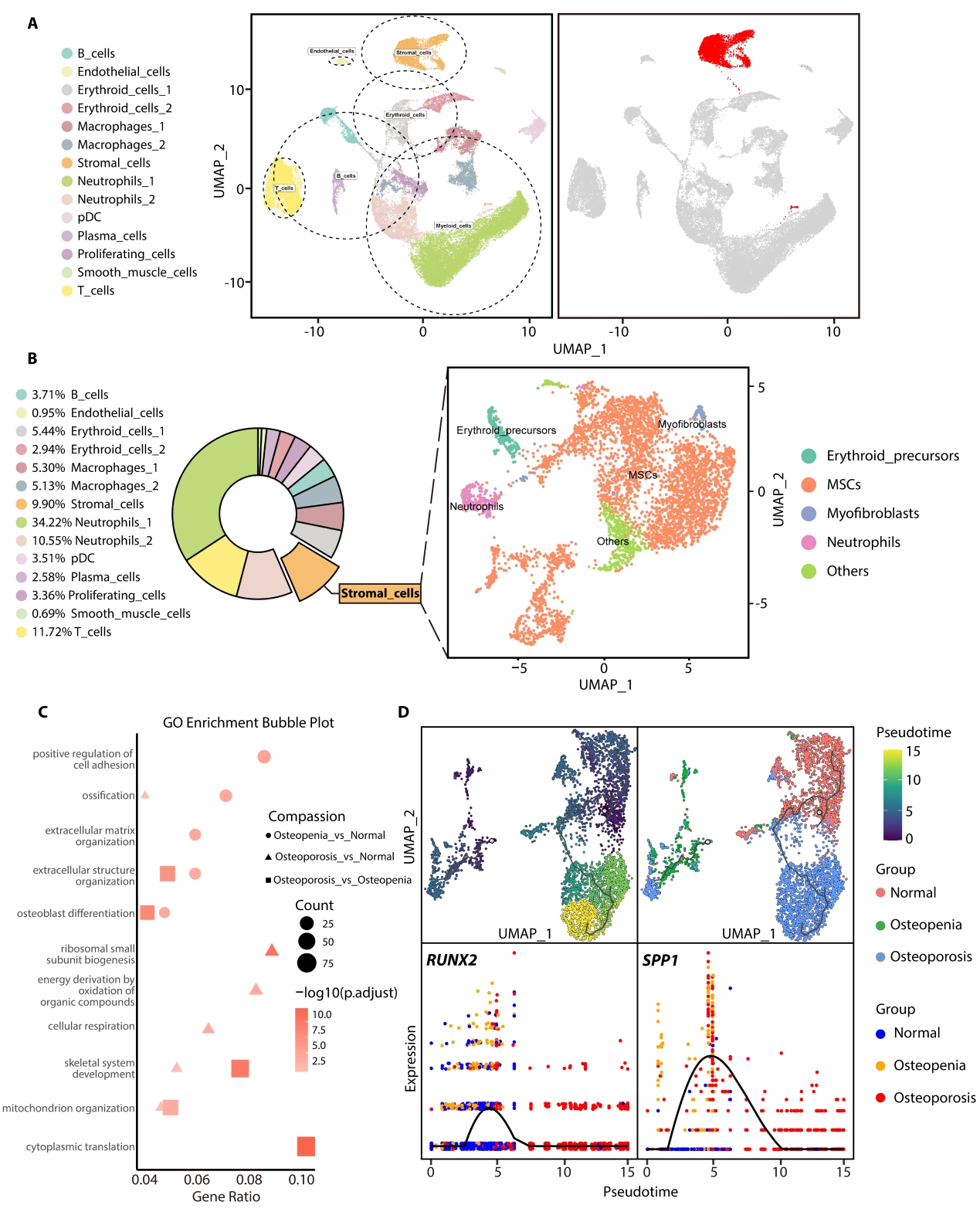
The study integrated public single-cell and spatial transcriptomic data to characterize impaired osteogenesis and mitochondrial function in mesenchymal stem cells (MSCs) under osteoporotic conditions. The pro-osteogenic and mitochondrial fission–promoting effects of estradiol (E2) were validated in ovariectomized mice and primary bone marrow MSCs. CUT&Tag-seq, RNA-seq, CUT&Tag-qPCR, and ERα knockdown were used to identify Pdk4 as a direct ERα transcriptional target. Conditional knockout, co-immunoprecipitation, mass spectrometry, site-directed mutagenesis, and in vitro kinase assays dissected the PDK4–MYH9–DRP1 axis. DRP1 inhibition, PDK4 inhibition, and the MYH9 S1943A mutant were used to test the requirement of mitochondrial fission for osteogenic commitment.
(4) Innovation
The work links estrogen signaling, mitochondrial dynamics, and MSC osteogenic commitment, proposing an ERα–PDK4–MYH9 axis. It identifies Pdk4 as a direct ERα transcriptional target; shows that PDK4 catalyzes MYH9 S1943 phosphorylation and promotes DRP1 mitochondrial recruitment, thereby driving mitochondrial fission; highlights a direct pro-osteogenic action of estrogen on MSCs beyond anti-resorption; and shows that Pdk4 overexpression improves bone mass in ovariectomized mice, suggesting PDK4 as a candidate molecular node for bone metabolism research.
(5) Material Development
No new materials, nanomaterials, or delivery systems were developed or characterized. E2, the DRP1 inhibitor Mdivi-1, expression plasmids, siRNA, and conditional knockout mice were used as pharmacological and genetic tools; material synthesis, carrier construction, and material-performance evaluation were not involved.
(6) Future Directions
Future work should define the causal contribution of the PDK4–MYH9 axis across bone lineage cells and the bone microenvironment, and evaluate how PDK4 modulation affects the balance between bone formation and energy metabolism. At the material and delivery level, bone-targeted carriers, responsive nanomaterials, or local modulation strategies may be explored, but should be advanced together with mechanistic specificity and safety evaluation.
We provide full-process services for various material designs (including highly innovative scheme design, preparation, characterization, in vitro and in vivo validation (cell/animal experiments), etc.): a postdoctoral team (with multiple high-impact publications in Zone 1 journals) can meet all kinds of tricky and challenging requirements, including hydrogels / drug delivery / nanomaterials / polymers / liposomes / microneedle drug delivery, etc. We can assist with project design / NSFC grant applications / publication of high-impact Zone 1 and Zone 2 papers in journals such as AFM, SCI, AM, etc. Welcome to consult 👇️
17768014569 (Senior Engineer Gao)
17761925168 (Engineer Zhang)
18013729810 (Engineer Yang)
#Osteoporosis #MitochondrialDynamics #PDK4 #MYH9 #OsteogenicDifferentiation #NanomaterialCustomization #ResearchServices #SciTalk #ResearchMaterials #BKNano
18915694570
Previous: Daily Ophthalmology Re
Next: Daily Ophthalmology Re


