
Daily Ophthalmology Research Idea | Multimodal Imaging and Molecular Mechanisms of Pigment Epithelial Detachment
(1) Journal Source
Progress in Retinal and Eye Research (2026, Vol. 115, Article 101512).
(2) Title
Original title: Retinal pigment epithelial detachment: Molecular mechanisms, multimodal imaging classification, and clinical management across the spectrum of macular disease.
(3) Research Approach
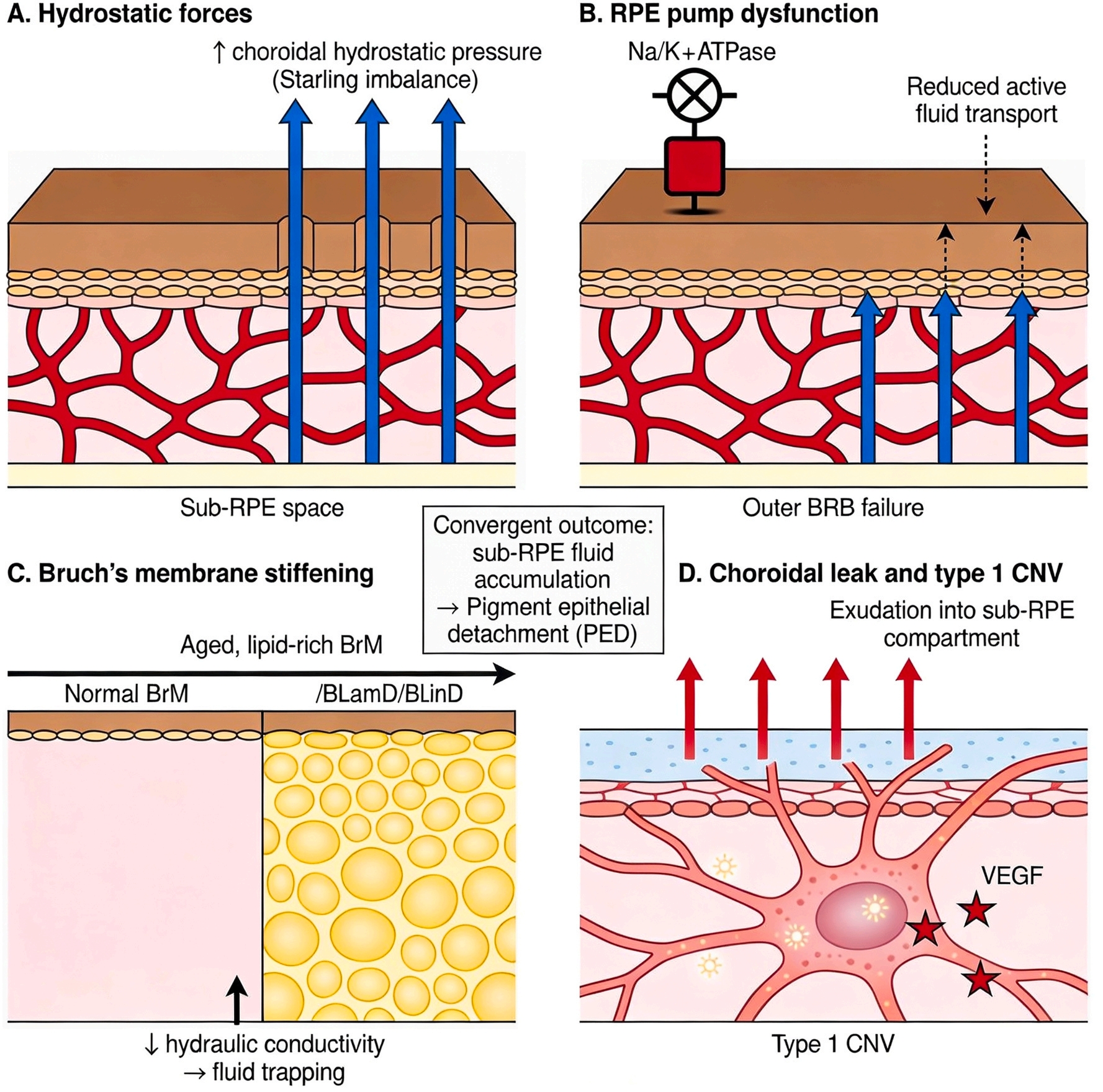
Based on the anatomy and physiology of the retinal pigment epithelium (RPE)–Bruch’s membrane complex, this review systematically outlines the mechanisms of PED formation, including hydrostatic/oncotic imbalance, RPE pump dysfunction, Bruch’s membrane stiffening and inflammatory microenvironment, choroidal vascular abnormalities, and molecular pathways involving VEGF, complement, and inflammation. It integrates multimodal imaging—OCT, OCTA, FA, ICGA, FAF, and FLIO—to discuss imaging features and differentiation of drusenoid, serous, fibrovascular, and hemorrhagic PED, summarizes natural history, treatment response, and complication risks such as RPE tears across subtypes, and outlines the potential of AI-assisted classification and imaging biomarkers for risk stratification.
(4) Innovation
It proposes an integrated anatomy–pathology–imaging–treatment framework for PED management; highlights the synergistic value of multimodal imaging in PED subtype identification, activity assessment, and complication risk stratification; links VEGF, complement, and inflammatory mechanisms with imaging phenotypes to explain differential treatment responses; systematically discusses the prognostic significance of PED height, volume, internal architecture (e.g., prechoroidal cleft, multilayered configuration), and morphological features; and notes the potential of AI and multiparametric models for precision stratification.
(5) Material Development
This is a review; no new materials, nanomaterials, or delivery systems were developed or characterized. The discussed content mainly involves imaging devices and contrast agents, anti-VEGF agents, photodynamic therapy photosensitizers, and corticosteroids, without material synthesis, carrier construction, or material-performance evaluation.
We provide full-process services for various material designs (including highly innovative scheme design, preparation, characterization, in vitro and in vivo validation (cell/animal experiments), etc.): a postdoctoral team (with multiple high-impact publications in Zone 1 journals) can meet all kinds of tricky and challenging requirements, including hydrogels / drug delivery / nanomaterials / polymers / liposomes / microneedle drug delivery, etc. We can assist with project design / NSFC grant applications / publication of high-impact Zone 1 and Zone 2 papers in journals such as AFM, SCI, AM, etc. Welcome to consult 👇️
17768014569 (Senior Engineer Gao)
17761925168 (Engineer Zhang)
18013729810 (Engineer Yang)
#PigmentEpithelialDetachment #MultimodalImaging #OCT #OCTA #AntiVEGF #NanomaterialCustomization #ResearchServices #SciTalk #ResearchMaterials #BKNano
18915694570
Previous: Daily Bone Implant Mat
Next: Daily Ophthalmology Re


