

Daily Ophthalmic AI Idea: Stabilizing Fundus Multi-Disease Detection with Foundation Models
(1) Abstract:
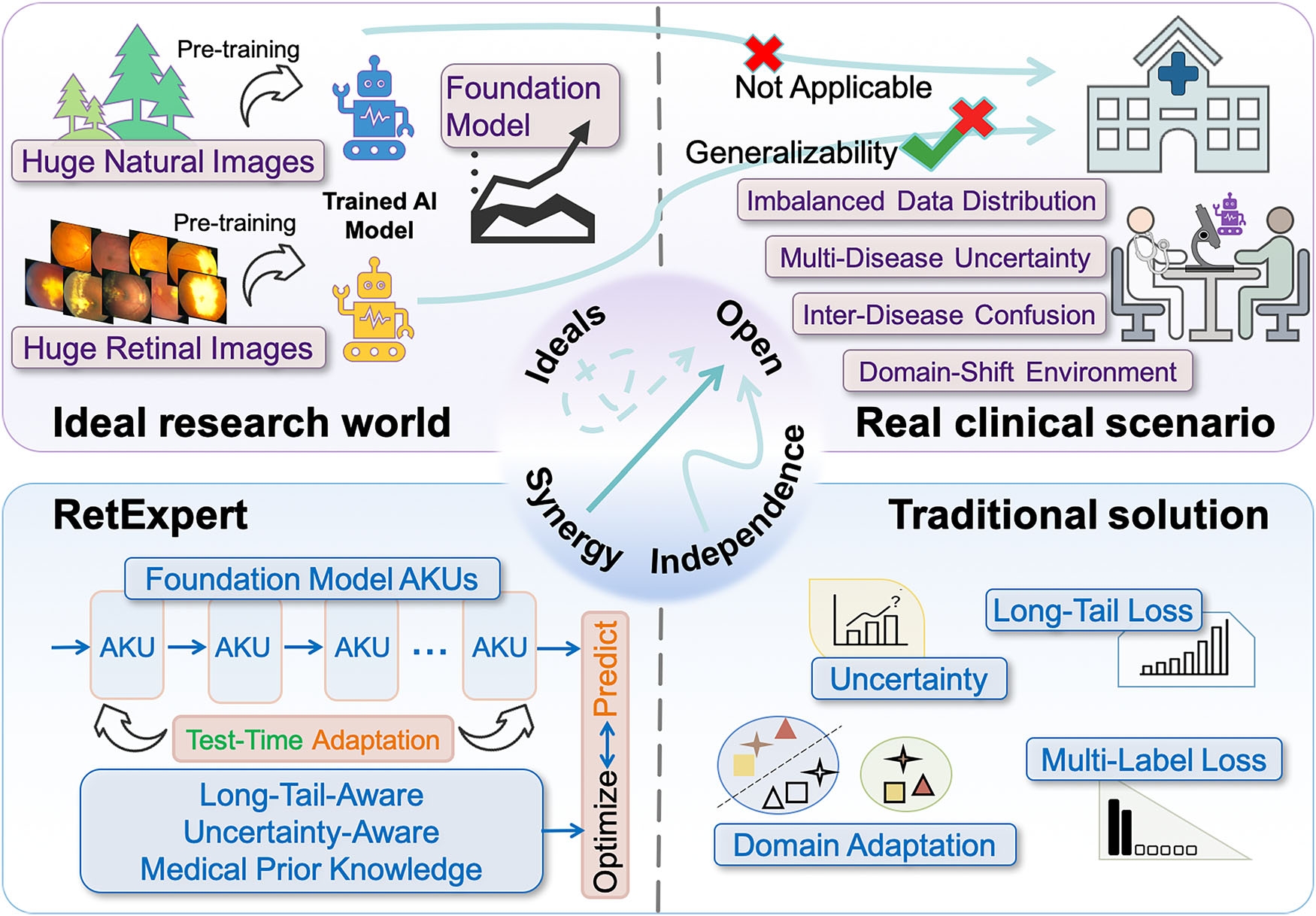
This study proposes RetExpert, a test-time clinically adaptive framework that enhances ophthalmic foundation models for multi-disease detection from color fundus photographs. It integrates adaptive knowledge units, stochastic one-hot activation, long-tail-aware learning, uncertainty-aware multi-label learning, a fundus disease co-occurrence matrix, and lightweight test-time adaptation to address data imbalance, multi-label uncertainty, inter-disease confusion, and domain shift.
(2) Background:
Fundus diseases are major causes of global vision impairment, and comorbid conditions are common in real-world settings. Conventional artificial intelligence often relies on large finely annotated datasets; multi-model integration is complex, and single models show limited cross-center generalization. Ophthalmic foundation models offer new opportunities, but multi-disease detection remains limited by long-tailed distributions, inter-disease confusion, and test-domain differences.
(3) Main Content:
RetExpert uses knowledge units from an ophthalmic foundation model, inserts lightweight adapters, and freezes the backbone. A stochastic one-hot activation module aligns intermediate knowledge-unit features with final knowledge-unit features to improve generalization. A long-tail-aware loss handles sparse multi-label data. An uncertainty-aware module estimates confidence separately for each disease head. A disease co-occurrence matrix serves as medical prior knowledge to constrain disease relationships, and a confusion score evaluates inter-disease confusion. Test-time adaptation combines unsupervised and pseudo-supervised learning, updating only adapters, normalization layers, and task heads without full retraining or cross-sample parameter accumulation.
(4) Study Design:
The model was developed on two multi-disease fundus datasets and validated on multiple public and private unseen datasets covering population and device domain shifts. It was compared with non-foundation models, RETFound, FLAIR, VisionFM, and several test-time adaptation methods using F1, Kappa, confusion score, AUROC, and AUPRC. Ablation analyses evaluated fine-tuning strategies, stochastic one-hot activation, uncertainty module, co-occurrence matrix, test-time adaptation stages, and batch size.
(5) Results:
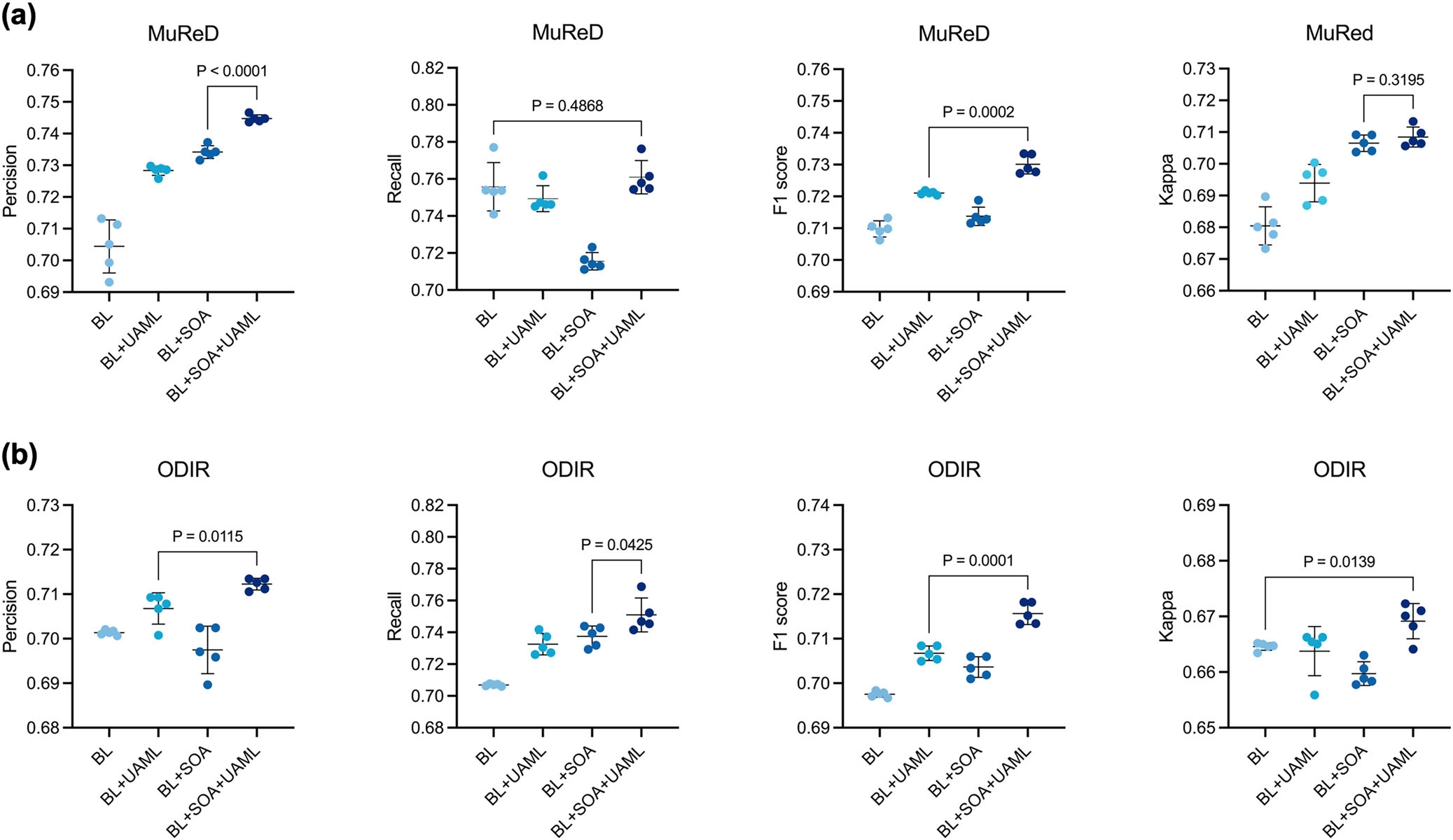
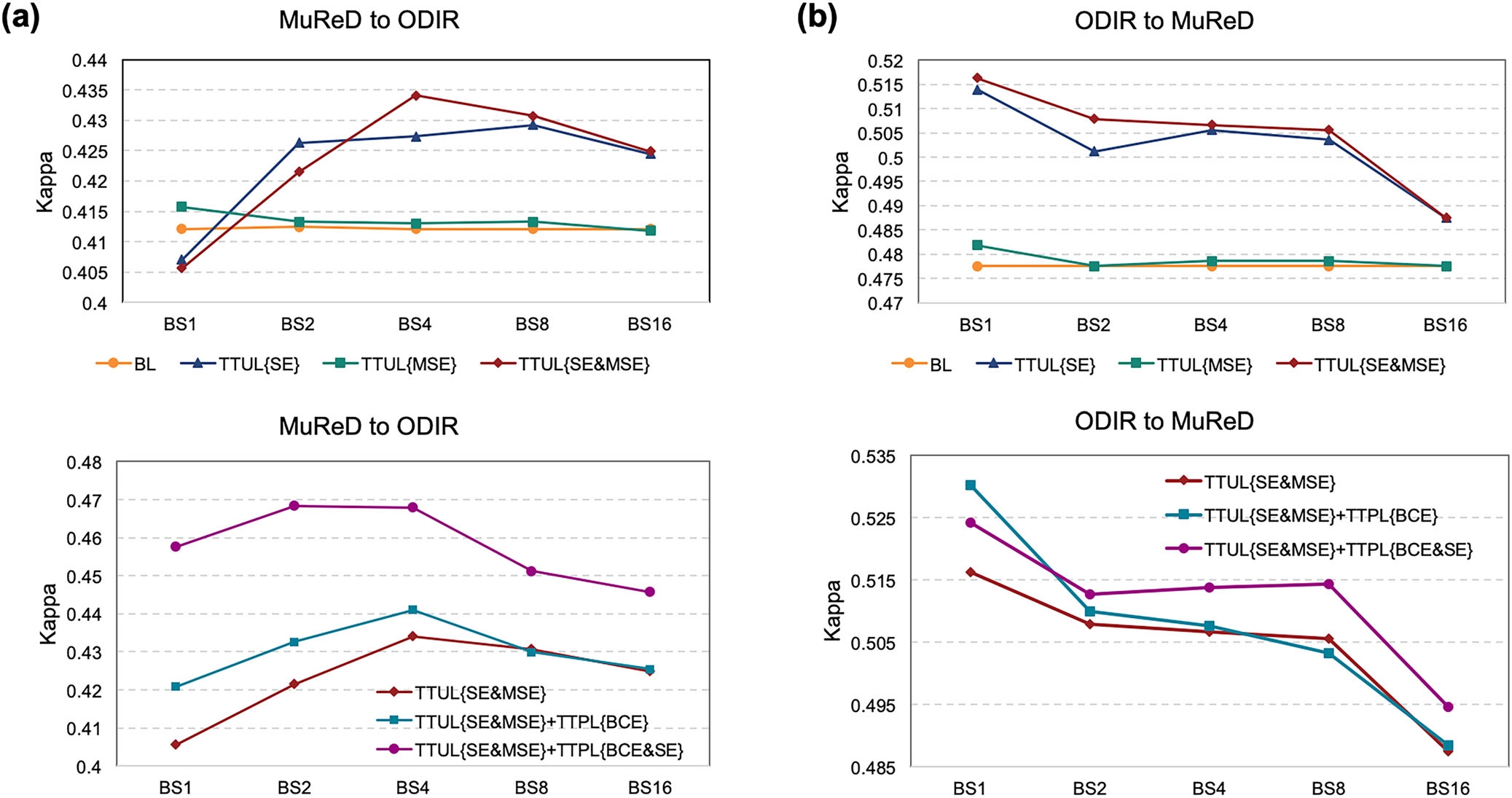
RetExpert generally outperformed non-foundation and ophthalmic foundation models on internal multi-disease datasets. Stochastic one-hot activation and the uncertainty module improved performance individually and jointly, and multi-value uncertainty outperformed single-value estimation. The co-occurrence matrix reduced confusion scores for multiple disease pairs without compromising overall performance. Under bidirectional domain shift, test-time adaptation outperformed baseline adaptation methods, and single-image batch processing also improved performance. Performance was generally favorable on multiple unseen datasets; for some tasks, AUROC differences from RETFound were not statistically significant, while other reliability metrics showed advantages. Hand-held low-resolution images remained challenging.
(6) Future Directions:
Performance depends on foundation model capability. Current inference requires graphics processing units, limiting real-time use on edge devices. The system is not a continual learning system and does not incrementally accumulate knowledge from new data. Test-time parameter control, reproducibility, and regulatory risks require further study. Future work may optimize foundation model adaptation, lightweight inference, continual learning, and test-time parameter constraints, with systematic validation in multicenter real-world settings.
We provide full-process services for various material designs (including highly innovative scheme design, preparation, characterization, in vitro and in vivo validation (cell/animal experiments), etc.): a postdoctoral team (with multiple high-impact publications in Zone 1 journals) can meet all kinds of tricky and challenging requirements, including hydrogels / drug delivery / nanomaterials / polymers / liposomes / microneedle drug delivery, etc. We can assist with project design / NSFC grant applications / publication of high-impact Zone 1 and Zone 2 papers in journals such as AFM, SCI, AM, etc. Welcome to consult 👇️17768014569 (Senior Engineer Gao)
17761925168 (Engineer Zhang)
18013729810 (Engineer Yang)
18915694570
Previous: Daily Bone Regeneratio
Next: Custom Nanomaterial Se


