

Nanomaterial Customization Service | New Breakthrough in Circadian Rhythm Regulation of Gala-SR Published in Bone Research

Overview
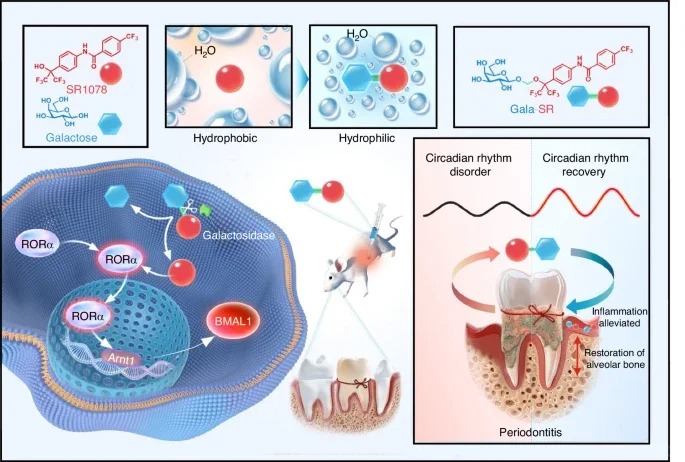
A joint research team from Huazhong University of Science and Technology and Sun Yat‑sen University has published a study in Bone Research. They successfully developed a galactose‑modified small‑molecule compound, Gala‑SR. By targeting RORα, a core regulator of the circadian clock, this compound markedly amplifies circadian rhythm amplitude and effectively alleviates periodontitis‑associated alveolar bone loss. It offers a new intervention strategy for diseases linked to circadian rhythm disruption.
Research Background & Rationale
Circadian rhythm disruption is closely associated with inflammatory diseases such as periodontitis. RORα acts as a key factor governing the core clock gene BMAL1. Its agonist SR1078 is limited for practical use owing to poor water solubility and high cytotoxicity. The team innovatively adopted a galactose prodrug modification strategy. Galactose was conjugated to SR1078 through a hydrolyzable linker to yield Gala‑SR, with the aim of improving its physicochemical properties and targeting performance.
Innovations
Prodrug design breakthrough: Galactose modification greatly improves the water solubility and biocompatibility of the compound, overcoming the application bottleneck of the parent agonist.
Precise circadian regulation: Gala‑SR only increases circadian rhythm amplitude without altering the period or phase, avoiding perturbation of normal circadian clock.
Multifunctional validation: In periodontitis models, it restores circadian rhythm, suppresses inflammation and attenuates bone loss simultaneously, confirming its synergistic effects across multiple pathways.
Material Development
Gala‑SR is synthesized with a cleavable acetal linkage, which enables specific hydrolysis by β‑galactosidase to release active SR1078. In vitro assays demonstrate that Gala‑SR potently activates RORα and upregulates the expression of clock genes including BMAL1 and Per2. In vivo animal experiments further verify its capacity to mitigate periodontal inflammation and reduce osteoclast activity.
Extended Perspectives
Related research directions: Targeting REV‑ERB nuclear receptors or the PER/CRY negative feedback loop may broaden the scope of circadian modulator development.
Interdisciplinary translation: Circadian regulation strategies may be extended to pathological studies of RORα‑related disorders such as metabolic diseases and immune dysregulation.
Natural product inspiration: Structural optimization of natural RORα ligands such as fucoxanthin provides new clues for small‑molecule design.
We provide full-process services for custom material design, including innovative scheme design, fabrication, characterization, and in vitro & in vivo validation (cell and animal studies). Our postdoctoral team with multiple high-impact Q1 publications can tackle your challenging research demands. Our scope covers hydrogels, drug delivery systems, nanomaterials, polymers, liposomes, microneedles and more. We support project design, NSFC proposal writing, and high-quality SCI manuscripts for journals such as AFM, AM and other Q1/Q2 journals. Enquiries are welcome
17768014569 (Dr.Gao)
17761925168 (Dr. Zhang)
18013729810 (Dr. Yang)
18915694570
Previous: Custom Nanomaterial Se
Next: Custom Nanomaterial Se


