

Custom Nanomaterial Service | Targeting GGT1 to Inhibit Breast Cancer Lung Metastasis in *Journal of Nanobiotechnology*
 (1) Journal source: Journal of Nanobiotechnology
(2) Title: Targeting GGT1 via RGD‑modified lipid nanoparticles suppresses breast cancer lung metastasis by disrupting exosome‑mediated angiogenesis
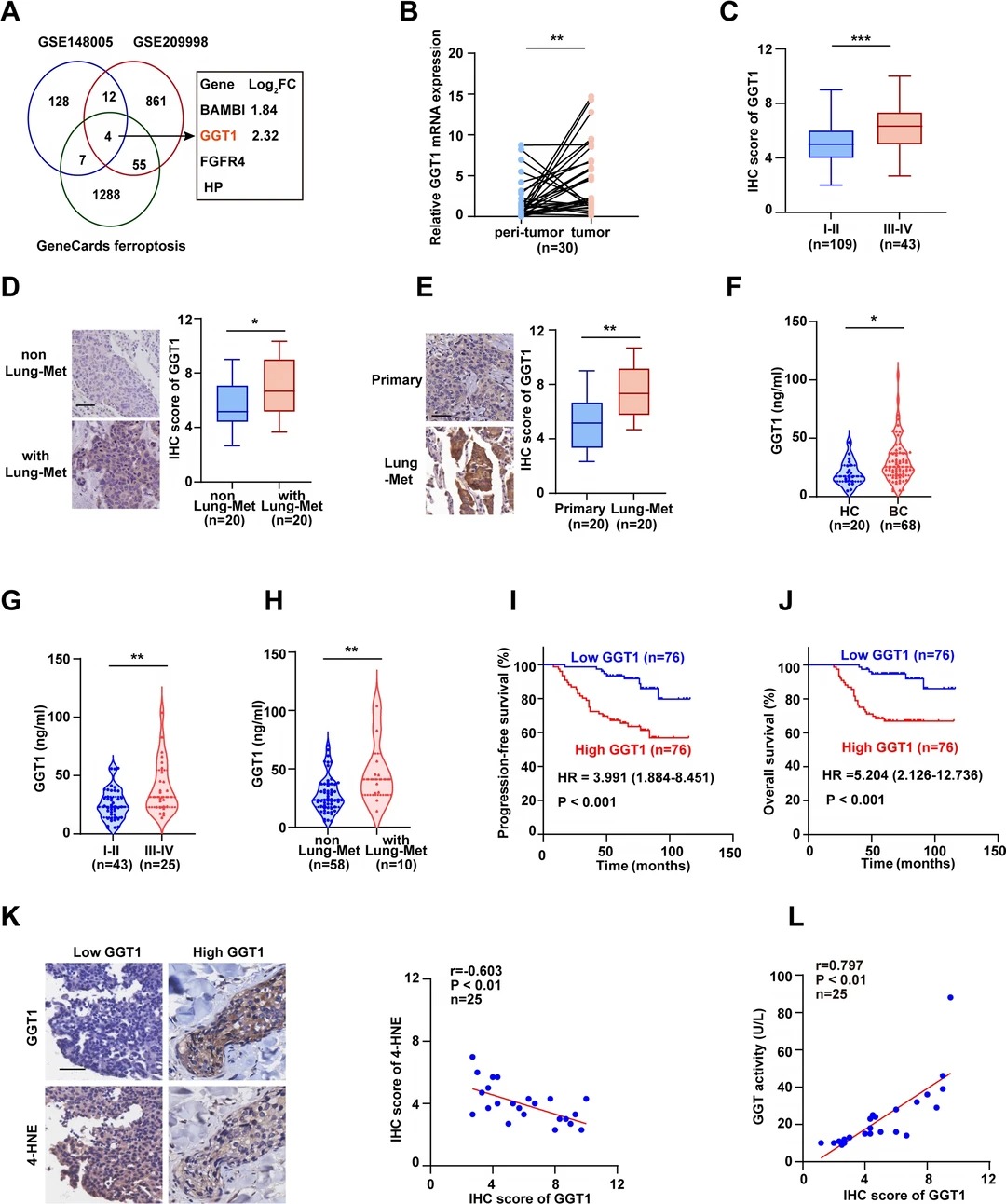
(3) Research highlights: Combining clinical sample analysis, cellular and animal models, this study clarifies the association between GGT1 and breast cancer lung metastasis, and dissects the dual mechanism by which exosomal GGT1 from tumors reprograms endothelial cells. RGD-modified lipid nanoparticles were constructed to deliver GGT1 siRNA, and the effects and molecular pathways of this system in inhibiting breast cancer lung metastasis were investigated both in vitro and in vivo.
(4) Innovations: ① Clinical cohorts confirm that high GGT1 expression correlates with lung metastasis and poor prognosis in breast cancer; ② It is revealed that exosomal GGT1, independent of its catalytic activity, upregulates VEGFA by facilitating the assembly of the JAK2‑STAT3 complex to drive angiogenesis; ③ Meanwhile, this study elucidates that exosomal GGT1 maintains the GSH/GPX4 axis to protect endothelial cells against ferroptosis; ④ RGD-modified LNPs were fabricated for the delivery of si‑GGT1, which acts on both tumor cells and endothelial cells to interfere with the metastatic microenvironment.
(5) Material development (1) Materials: Cyclic RGD peptide-modified lipid nanoparticles RGD‑LNPs‑si‑GGT1 loaded with GGT1-targeted siRNA were prepared via microfluidic self-assembly; control LNPs without RGD modification were obtained by co-preparation. (2) Functions: The LNP carrier prolongs the circulation time of nucleic acids in vivo; RGD modification enhances cellular uptake and enables accumulation in tumors and lung metastatic lesions; GGT1 silencing attenuates the pro-angiogenic effect of tumor exosomes, abrogates the ferroptosis resistance of endothelial cells, and suppresses the progression of lung metastasis.
(6) Outlook for further research: The applicability of this mechanism in other breast cancer subtypes can be further explored; the biological functions of different fractions of circulating GGT1 can be distinguished; the proportion of RGD ligands can be optimized; cell-specific delivery systems can be developed to differentiate the respective contributions of tumor cells and endothelial cells.
We provide full-process services for custom material design, including innovative scheme design, fabrication, characterization, and in vitro & in vivo validation (cell and animal studies). Our postdoctoral team with multiple high-impact Q1 publications can tackle your challenging research demands. Our scope covers hydrogels, drug delivery systems, nanomaterials, polymers, liposomes, microneedles and more. We support project design, NSFC proposal writing, and high-quality SCI manuscripts for journals such as AFM, AM and other Q1/Q2 journals. Enquiries are welcome👇
17768014569 (Dr.Gao)
17761925168 (Dr. Zhang)
18013729810 (Dr. Yang)
18915694570
Previous: Custom Nanomaterial Se
Next: Custom Nanomaterial Se


