

Customized Nanomaterial Services | MOF-hydrogel overcomes periodontitis in "Journal of Nanobiotechnology"

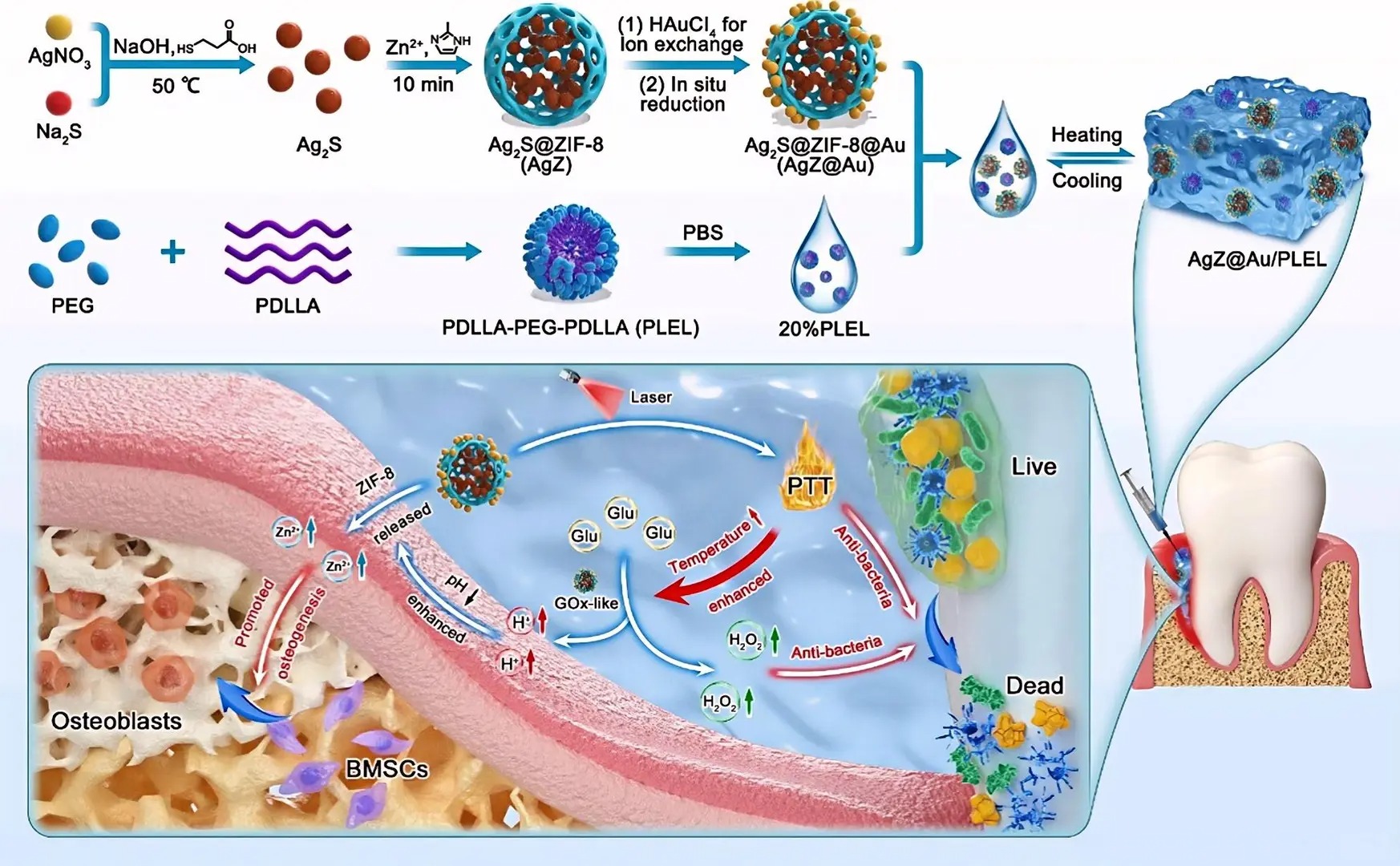 (1) Journal source: Journal of Nanobiotechnology
(2) Title: Reprogramming the periodontal microenvironment: MOF‑hydrogel composites as emerging platforms for periodontitis therapy
(3) Research highlights: This paper systematically reviews MOF‑hydrogel composite systems, summarizes three preparation strategies including direct blending, in-situ growth and one-step synthesis, and analyzes how such composite platforms leverage the synergistic advantages of MOFs and hydrogels to achieve antibacterial, antioxidant, immunomodulatory and periodontal tissue regeneration effects, thereby remodeling the pathological periodontal microenvironment. Meanwhile, it compares these composites with existing periodontal therapeutic materials, sorts out current research limitations and puts forward prospects for future research.
(4) Innovations: ① Unlike previous reviews that separately discussed MOFs or hydrogels, this review specifically focuses on MOF‑hydrogel composite systems in the field of periodontitis; ② It systematically summarizes three types of composite preparation processes and analyzes the structural differences caused by these processes; ③ It categorizes and sorts out composite systems loaded with different functional components such as metal ions, antibacterial agents, natural active substances, nanozymes and growth factors, together with their action mechanisms; ④ It analyzes the material challenges arising from the complex oral environment, and proposes research development directions from the perspectives of material stability, model selection, system diversification and theranostic integration.
(5) Material development (1) Materials: Various hydrogels are used as the matrix; metal‑organic frameworks including ZIF‑8, FeCuMOF, Mg‑GA MOF and Ag-based MOF are selected; functional components such as antibacterial drugs, natural active molecules, nanozymes and growth factors can be loaded to construct MOF‑hydrogel composites. (2) Functions: Hydrogels endow the composites with injectability, tissue adhesion, local retention and a biomimetic extracellular matrix environment; MOFs perform functions including drug loading, stimuli-responsive drug release, metal ion release and enzyme-mimicking catalytic effects. The composite systems can realize antibacterial and anti-biofilm effects, scavenge ROS, regulate macrophage phenotypes, inhibit osteoclast differentiation, and promote osteogenesis and angiogenesis.
(6) Extended perspectives: Future research can diversify MOF systems beyond ZIF‑8; conduct evaluations using improved large animal models; explore the mechanical, adhesive and stimuli-responsive behaviors of materials under the dynamic oral environment; develop multi-responsive and sequential drug release systems; and explore intelligent material strategies integrating sensing and therapy, artificial intelligence and additive manufacturing.
We provide full-process services for custom material design, including innovative scheme design, fabrication, characterization, and in vitro & in vivo validation (cell and animal studies). Our postdoctoral team with multiple high-impact Q1 publications can tackle your challenging research demands. Our scope covers hydrogels, drug delivery systems, nanomaterials, polymers, liposomes, microneedles and more. We support project design, NSFC proposal writing, and high-quality SCI manuscripts for journals such as AFM, AM and other Q1/Q2 journals. Enquiries are welcome👇
17768014569 (Dr.Gao)
17761925168 (Dr. Zhang)
18013729810 (Dr. Yang)
18915694570
Previous: One Ophthalmology Idea
Next: Custom Nanomaterial Se


