

One Ophthalmology Idea a Day:Nanomaterials for Sensing and Therapy
(1) Abstract
This review summarizes nanomaterial-enabled smart contact lenses that combine vision correction with sensing, therapy, and theranostics. Nanomaterials provide electrochemical, plasmonic, and Raman detection, controlled release, photothermal, and antibacterial functions, allowing continuous contact with tear fluid to access ocular and systemic biomarkers. Material design, functional integration, and evaluation challenges are discussed.
(2) Background
Smart contact lenses can continuously interface with tear fluid without disturbing vision and offer potential for drug delivery and local therapy. Conventional hydrogels or silicone hydrogels provide oxygen permeability, transparency, and comfort but lack sensing and active therapeutic functions. The high surface-to-volume ratio and tunable optical, electrical, and catalytic properties of nanomaterials provide a basis for multifunctional integration while requiring attention to transparency, oxygen permeability, and ocular surface safety.
(3) Main Content
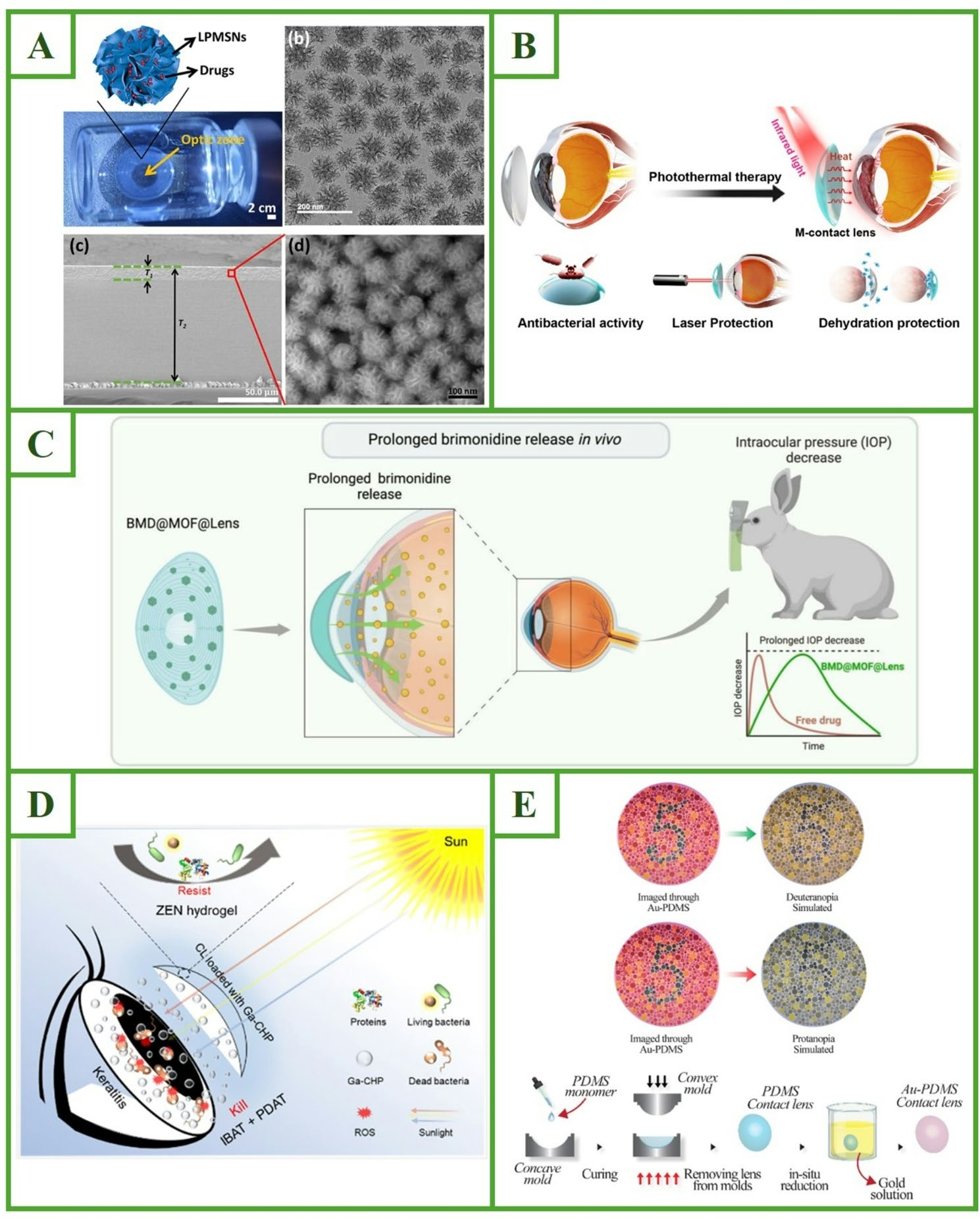
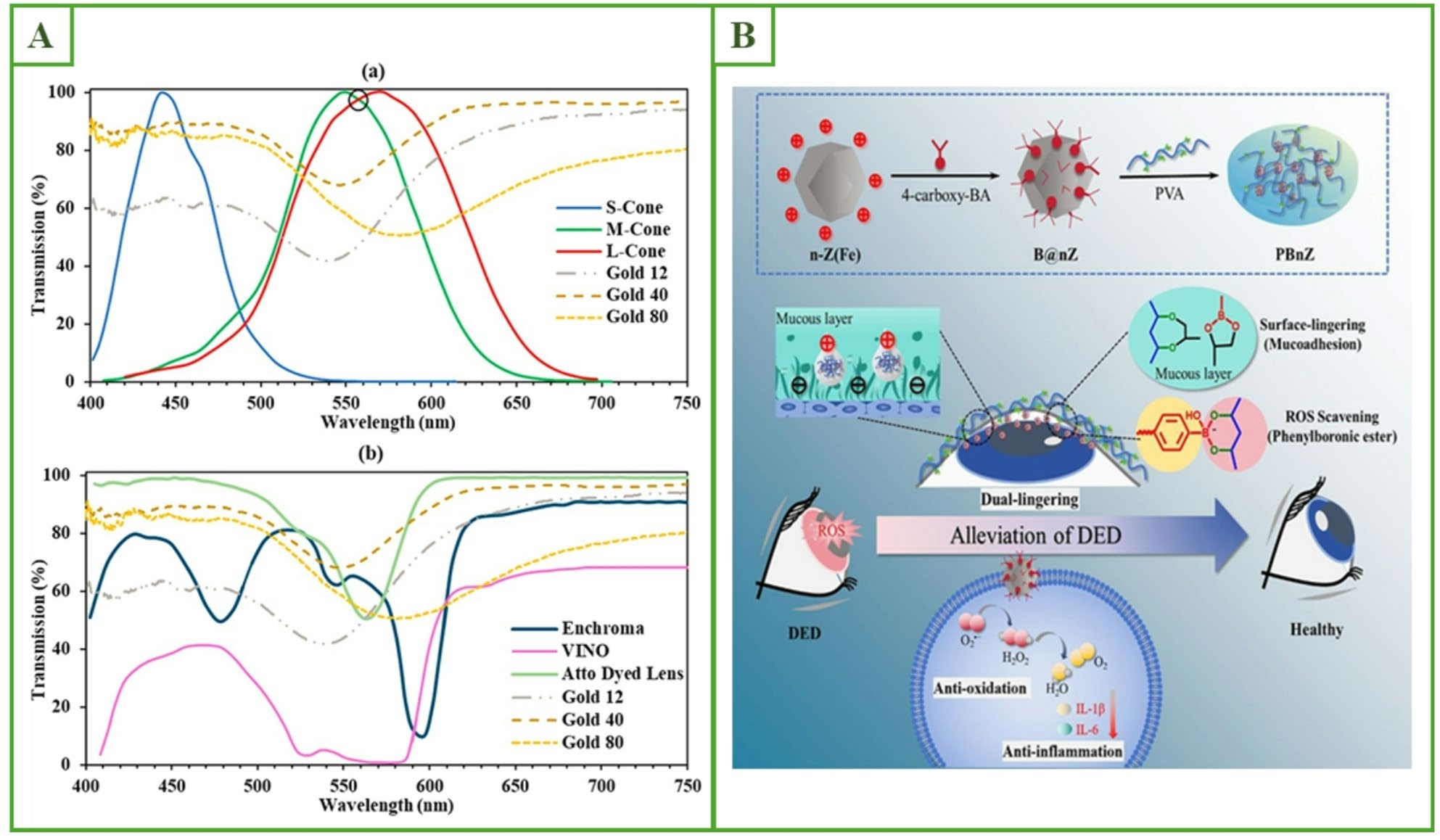
The review outlines lens substrates and manufacturing methods; compares metallic, carbon-based, two-dimensional, silica-based, organic, and hybrid nanomaterials in function and limitations; discusses tear fluid as a diagnostic medium and biomarkers including glucose, lactate, electrolytes, proteins, cytokines, and emerging markers; summarizes electrochemical, colorimetric, Raman, and intraocular pressure sensing, as well as controlled drug release, photothermal, electrical stimulation, antibacterial, color vision correction, and nanozyme therapy; and introduces theranostic closed-loop systems.
(4) Study Design
This is a narrative review. The authors integrate polymer or hydrogel matrices, nanomaterial classes and properties, tear biomarkers, sensing and therapeutic applications, theranostics, and challenges. They compare material integration strategies and device functions and highlight key issues in sensor validation, long-term biocompatibility, power supply, and evaluation standards.
(5) Results
The review indicates that nanomaterials can enable transparent conductive electrodes, plasmonic or Raman sensing, high-loading controlled release, and photothermal or catalytic therapy within hydrogels. Tear biomarkers support continuous monitoring, but low concentrations, sampling, and standardization limit reliability. Multifunctional lenses must balance optical transparency, oxygen permeability, mechanical comfort, and nanomaterial stability. Theranostic lenses can link sensing to triggered release, but long-term wear safety, power supply, and device evaluation require systematic study.
(6) Future Directions
Future work should strengthen long-term ocular surface biocompatibility and nanomaterial leaching or aggregation evaluation, establish tear sampling and sensor calibration standards, and develop low-power wireless power supply and multiplexed biomarker detection. Combining nanozymes, microfluidics, and intelligent algorithms may build more reliable closed-loop ocular health monitoring and on-demand intervention platforms, with systematic evaluation of material-device-biological interfaces.
We provide full-process services for various material designs (including highly innovative scheme design, preparation, characterization, in vitro and in vivo validation (cell/animal experiments), etc.): a postdoctoral team (with multiple high-impact publications in Zone 1 journals) can meet all kinds of tricky and challenging requirements, including hydrogels / drug delivery / nanomaterials / polymers / liposomes / microneedle drug delivery, etc. We can assist with project design / NSFC grant applications / publication of high-impact Zone 1 and Zone 2 papers in journals such as AFM, SCI, AM, etc. Welcome to consult 👇️
17768014569 (Senior Engineer Gao)
17761925168 (Engineer Zhang)
18013729810 (Engineer Yang)
18915694570
Previous: Custom Nanomaterial Se
Next: Custom Nanomaterial Se


