

Custom Nanomaterial Service | Oral Cisplatin Nanotherapy Targeting Central Lymphoma Using Gut Macrophage Carriers in Biomaterials 2027
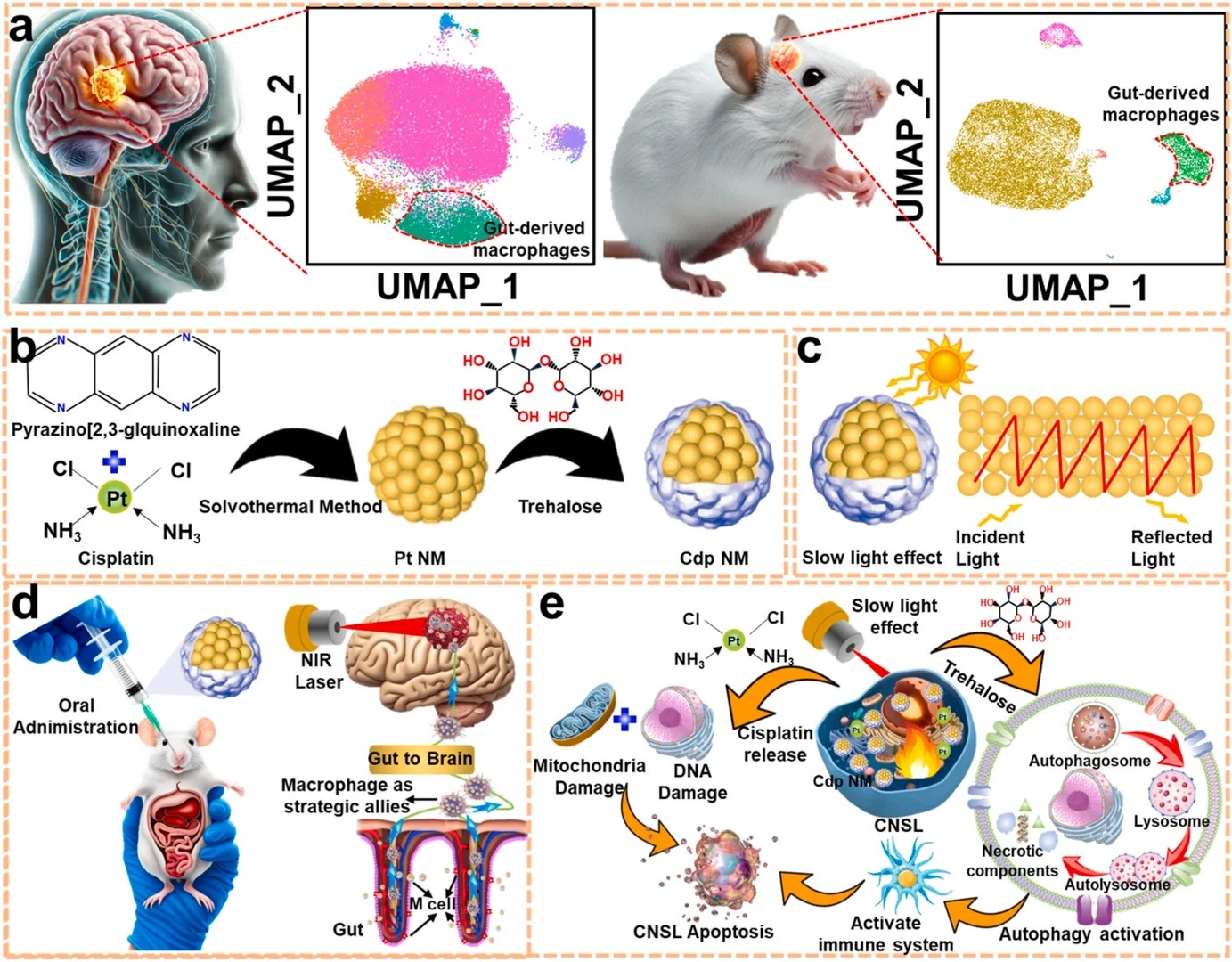 1. Study Overview: Central nervous system lymphoma (CNSL) is shielded by the blood-brain barrier, resulting in extremely low brain penetration efficiency of conventional chemotherapy. Using single-cell sequencing, this study first verified that intestinal macrophages can migrate to brain tumor lesions via the Csf2ra pathway. Based on this finding, a pomegranate-shaped cisplatin nanoagent Cdp NM was constructed. Its outer trehalose layer targets intestinal organic anion transporters; after oral administration, the nanoagent is taken up by intestinal macrophages and transported into the brain along the gut-brain axis. The rough nanostructure exhibits a slow-light effect. Irradiation with near-infrared laser triggers site-specific drug release within the tumor microenvironment, while trehalose simultaneously induces macrophage autophagy to synergize with chemotherapy and activate anti-tumor immunity. In mouse models of primary and two-stage secondary CNSL, oral administration combined with laser treatment reduced tumor lesions and prolonged survival, with no obvious toxicity observed in major organs.
2. Core Innovations: This study is the first to confirm that intestinal macrophages serve as natural endogenous delivery vehicles for brain tumors, establishing a novel non-invasive oral gut-brain drug delivery strategy. The integrated nanoagent achieves three functions simultaneously: targeted accumulation, light-controlled drug release, and autophagy-mediated immune activation. Unlike invasive intracranial drug delivery, this approach relies on the transport of the body’s own immune cells, which greatly reduces systemic side effects and provides a non-invasive nanotherapeutic paradigm for intracranial malignant tumors.
3. Key Material Design and Validation: A cisplatin-pyrazinoquinoxaline core was synthesized via a solvothermal method, and the shell was modified with thiotrehalose. Characterizations including particle size, morphology, gastrointestinal stability and near-infrared photothermal performance were carried out. In vitro assays were performed to validate macrophage uptake, tumor spheroid penetration and cytotoxicity. In vivo tracing was used to monitor the whole process of intestinal uptake, lymphatic transport and brain accumulation after oral dosing. Two types of CNSL animal models were established for multi-dimensional efficacy and mechanistic validation covering body weight, survival time, tumor volume, immune infiltration and transcriptome profiles.
4. Insights and Outlook: (1) Reverse thinking: Instead of engineering carriers to cross the brain barrier, the inherent gut-immune-brain cellular pathway of the body is harnessed to realize non-invasive oral drug delivery. (2) Systematic design: A complete validation pipeline from single-cell mechanistic exploration and multifunctional nanoformulation construction to testing on cells, tumor spheroids and two animal models. (3) Platform potential: The macrophage-mediated oral nano-delivery framework can be extended to a variety of brain solid tumors such as glioblastoma.
5. Article Information: (1) Journal: Biomaterials 2027 (2) Title: Gut-derived macrophages as endogenous carriers for brain-targeted cisplatin nanotherapy
We provide full-process services for custom material design, including innovative scheme design, fabrication, characterization, and in vitro & in vivo validation (cell and animal studies). Our postdoctoral team with multiple high-impact Q1 publications can tackle your challenging research demands. Our scope covers hydrogels, drug delivery systems, nanomaterials, polymers, liposomes, microneedles and more. We support project design, NSFC proposal writing, and high-quality SCI manuscripts for journals such as AFM, AM and other Q1/Q2 journals. Enquiries are welcome👇
17768014569 (Dr.Gao)
17761925168 (Dr. Zhang)
18013729810 (Dr. Yang)
18915694570
Previous: Custom Nanomaterial Se
Next: Custom Nanomaterial Se


