

Cross-Altitude Ophthalmic Foundation Models

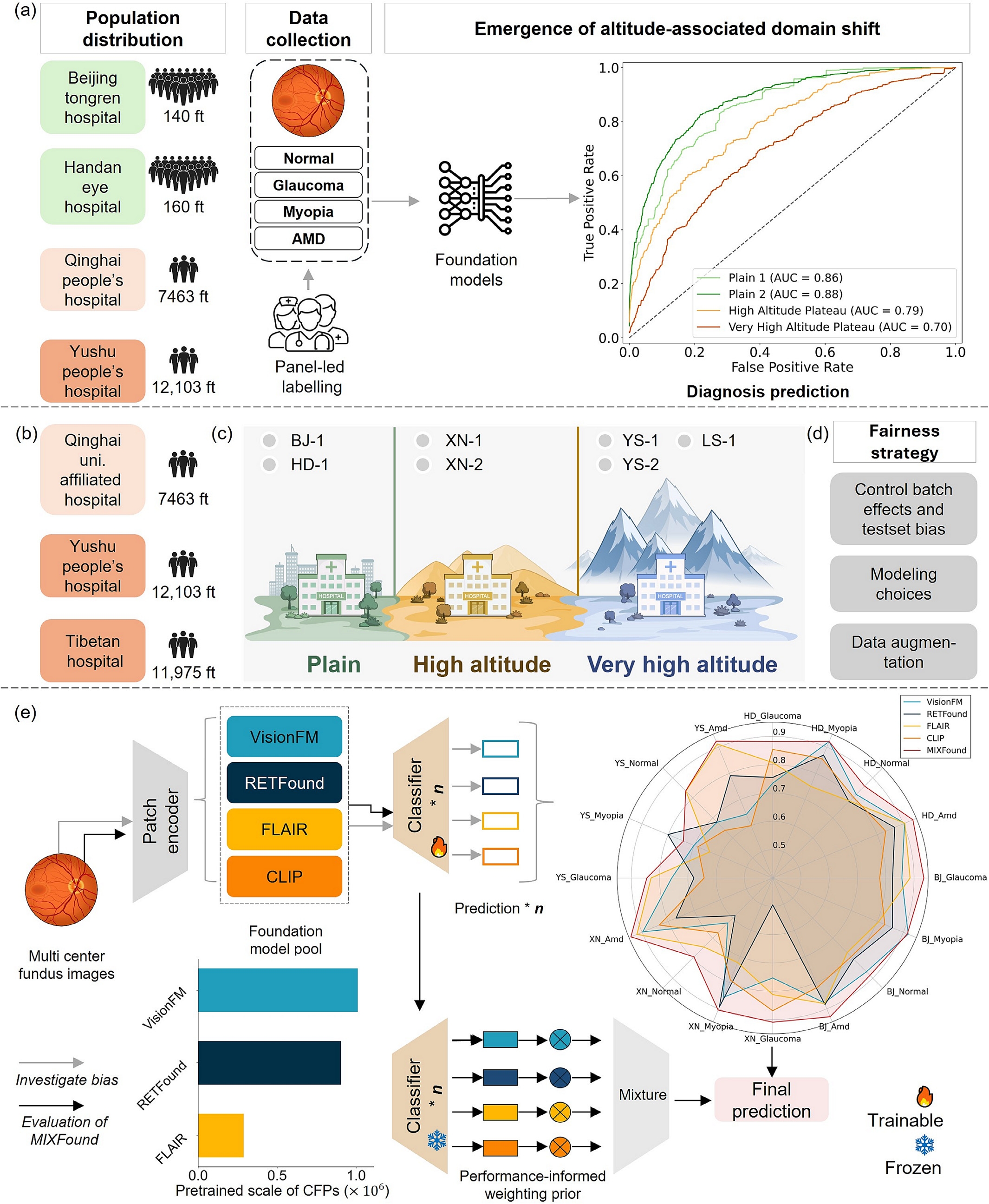
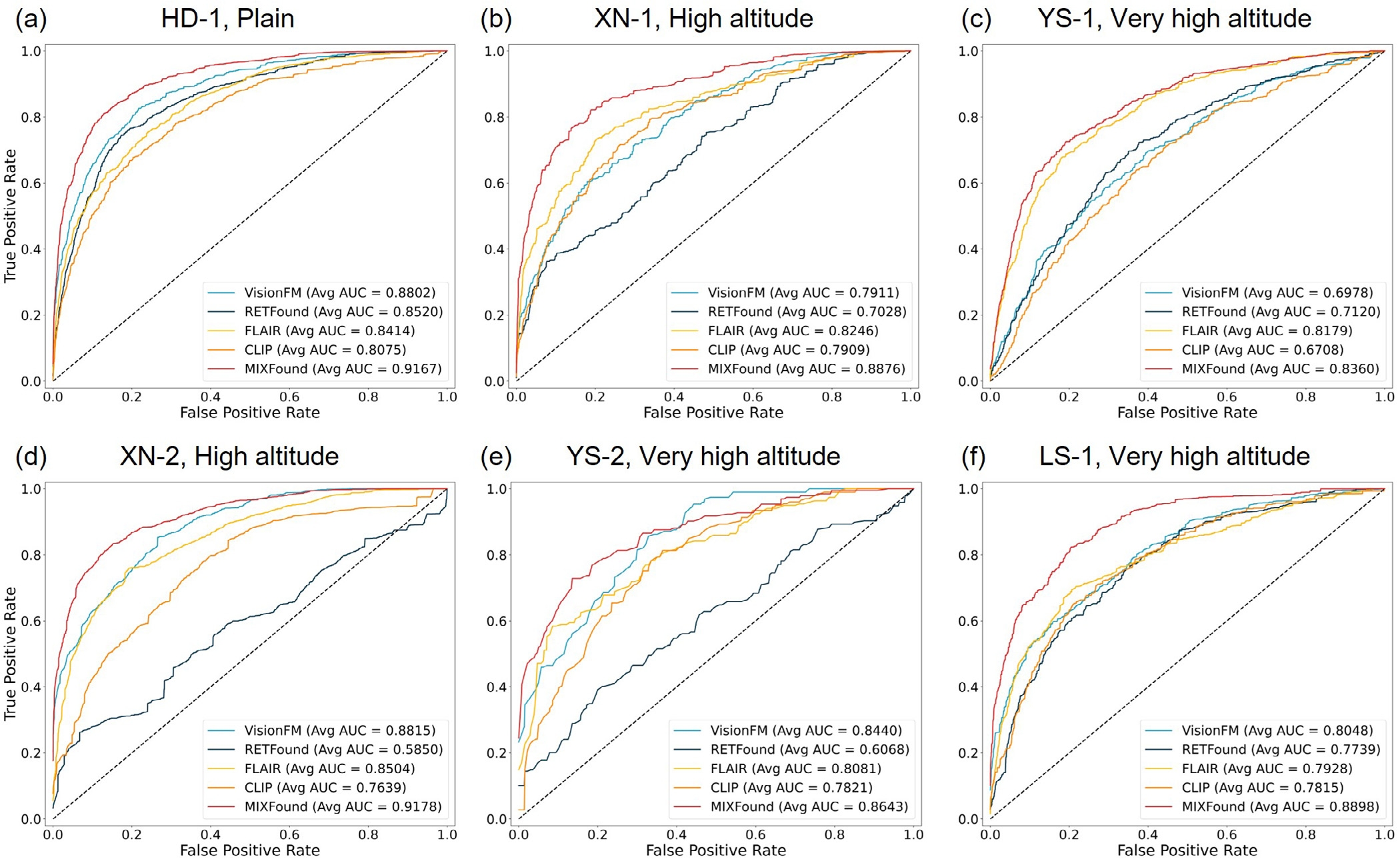
(1) Abstract: This study systematically evaluates performance differences of ophthalmic foundation models under cross-altitude deployment scenarios and identifies pronounced domain shift in fundus images from high-altitude populations. The authors develop MIXFound, a mixture-of-foundation-models framework that fuses multiple frozen model representations through performance-informed weighting, improving cross-altitude diagnostic robustness without retraining backbones, and analyze altitude-associated adaptive changes in retinal vascular morphology.
(2) Background: Existing multimodal ophthalmic foundation models are mostly pretrained on plain-area or public databases, and fairness studies mainly focus on demographic axes such as sex and race, lacking investigation of geographic environments, especially high-altitude hypoxia. High-altitude populations are underrepresented in data and medical resources, potentially reducing model generalization in this group and constituting a neglected deployment domain shift.
(3) Main Content: Fundus photographs were collected from multiple medical centers covering plain, high-altitude, and very-high-altitude regions, including normal, glaucoma, myopia, and age-related macular degeneration categories. The cross-altitude performance of foundation models including RETFound, VisionFM, FLAIR, and CLIP was compared, altitude-associated domain shift was analyzed, and MIXFound was proposed, combining performance weighting with trainable classifier heads for fusion.
(4) Study Design: A cross-altitude multi-disease fundus image dataset was constructed and annotated. Model performance was evaluated internally and externally in demographically controlled cohorts. Paired bootstrap tests, ablation experiments, and comparisons with multiple fusion strategies were used to validate MIXFound. AutoMorph was used to quantify retinal vascular morphology in healthy eyes and analyze altitude-associated vascular adaptations.
(5) Results: All models generally showed performance degradation with increasing altitude, while MIXFound maintained relatively high or the highest discriminative ability in most cohorts, with smaller cross-altitude performance loss. External high-altitude center validation supported its robustness. Retinal vascular morphology analysis showed differences in multiple indices across altitude groups, suggesting vascular adaptations as one anatomical basis for domain shift. Ablation experiments indicated that constituent foundation models provide complementary information, although residual subgroup performance gaps remained.
(6) Future Directions: Further work should include high-altitude cohorts from more regions and populations and disentangle altitude from population characteristics, imaging devices, and acquisition protocols. Standardized acquisition metadata and fairness-aware optimization should be combined to further dissect sources of domain shift, and the robustness and generalizability of the fusion framework should be validated in prospective multicenter data.
We provide full-process services for various material designs (including highly innovative scheme design, preparation, characterization, in vitro and in vivo validation (cell/animal experiments), etc.): a postdoctoral team (with multiple high-impact publications in Zone 1 journals) can meet all kinds of tricky and challenging requirements, including hydrogels / drug delivery / nanomaterials / polymers / liposomes / microneedle drug delivery, etc. We can assist with project design / NSFC grant applications / publication of high-impact Zone 1 and Zone 2 papers in journals such as AFM, SCI, AM, etc. Welcome to consult 👇️
17768014569 (Senior Engineer Gao)
17761925168 (Engineer Zhang)
18013729810 (Engineer Yang)
18915694570
Previous: Nanomaterial Customiza
Next: Custom Nanomaterial Se


