

Custom Synthesis of Nanomaterials | Ultrasound-Activated Intracellular Piezoelectric Microdomains for Modulating Bone Regeneration, Bioactive Materials
✨Source
Bioactive Materials
📄Original Title
Ultrasonic-driven force-electric nanodomains orchestrate lysosome-to-mitochondria functional cascade to accelerate bone regeneration
🔍Research
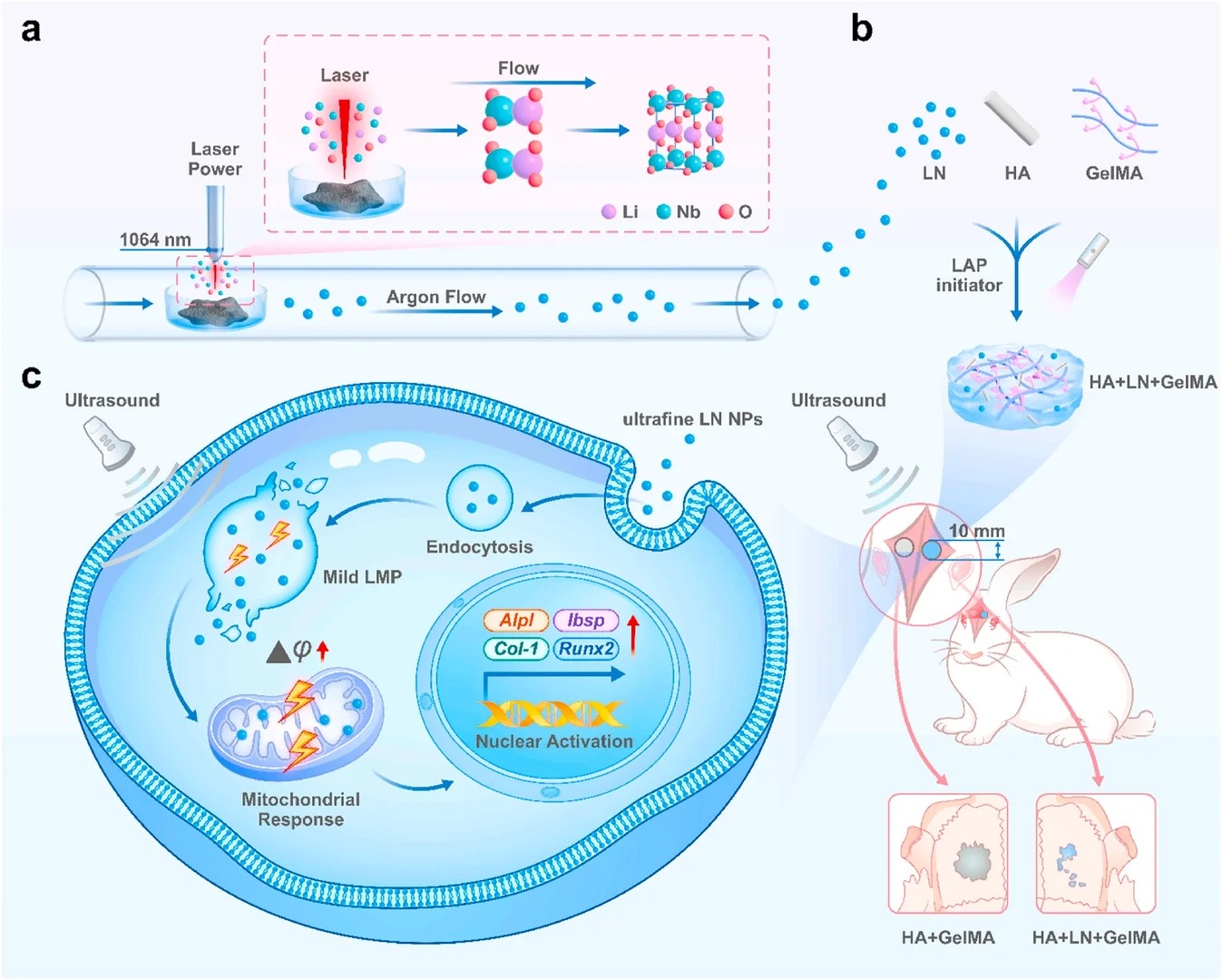
Idea To address the limitation of conventional piezoelectric bone repair materials, which only deliver electromechanical signals outside the cell membrane and cannot precisely regulate osteogenesis-related intracellular organelles, ultrafine lithium niobate piezoelectric nanoparticles are fabricated to construct intracellular force-electric microdomains under ultrasound stimulation. Multi-level validations covering material physicochemical characterization, cellular uptake and subcellular organelle responses, osteogenic differentiation molecular pathways, and in vivo calvarial defect repair are performed, to decipher the complete mechanism by which intracellular force-electric signals modulate lysosome-mitochondria crosstalk to promote osteogenesis.
💡Highlights
① Breaking the traditional extracellular piezoelectric stimulation paradigm to realize direct piezoelectric signal action on intracellular organelles; ② Verifying that ultrafine size and intrinsic piezoelectricity are two indispensable physical prerequisites for intracellular force-electric regulation; ③ Uncovering that ultrasound-activated nanoparticles induce mild and reversible lysosomal perturbation, establishing a lysosome-mitochondria cascade regulatory axis; ④ Identifying PI3K–AKT–Ibsp as the core osteogenic mediating pathway via transcriptomic analysis; ⑤ Developing an HA/GelMA composite hydrogel carrier for long-term in vivo ultrasound-responsive force-electric stimulation.
🧱Material Development
(1) Materials: Ultrafine LiNbO₃ nanoparticles with an average size of ~15 nm synthesized via pulsed laser vaporization; implantable composite scaffolds composed of hydroxyapatite and photo-crosslinkable GelMA hydrogel; large-sized LiNbO₃, non-piezoelectric cubic barium titanate and piezoelectric tetragonal barium titanate are set as control groups. (2) Function: Ultrafine LiNbO₃ possesses a stable trigonal piezoelectric crystal structure and can generate biologically compatible millivolt-scale localized potential upon ultrasound irradiation. The nanoparticles are internalized and enriched in lysosomes. Upon ultrasound activation, they trigger controllable disruption of lysosomal proton homeostasis, boost mitochondrial activity and activate downstream osteogenic transcriptional programs. The composite hydrogel features favorable cell adhesion, degradability and sustained nanoparticle release capacity.
We provide full-process services for custom material design, including innovative scheme design, fabrication, characterization, and in vitro & in vivo validation (cell and animal studies). Our postdoctoral team with multiple high-impact Q1 publications can tackle your challenging research demands. Our scope covers hydrogels, drug delivery systems, nanomaterials, polymers, liposomes, microneedles and more. We support project design, NSFC proposal writing, and high-quality SCI manuscripts for journals such as AFM, AM and other Q1/Q2 journals. Enquiries are welcome👇
17768014569 (Dr.Gao)
17761925168 (Dr. Zhang)
18013729810 (Dr. Yang)
18915694570
Previous: BK Oncolytic virus pla
Next: Atomic-level Regulatio


