
Custom Nanomaterial Service | Targeted Elimination of Postoperative Residual Tumors by Nanobacteria in *Advanced Materials*
 📑Journal Source: Advanced Materials
📌Title: Self‑Fueling Nanobacteria Harnesses Leaked Pancreatic Fluid to Eradicate Residual Tumors After Surgery
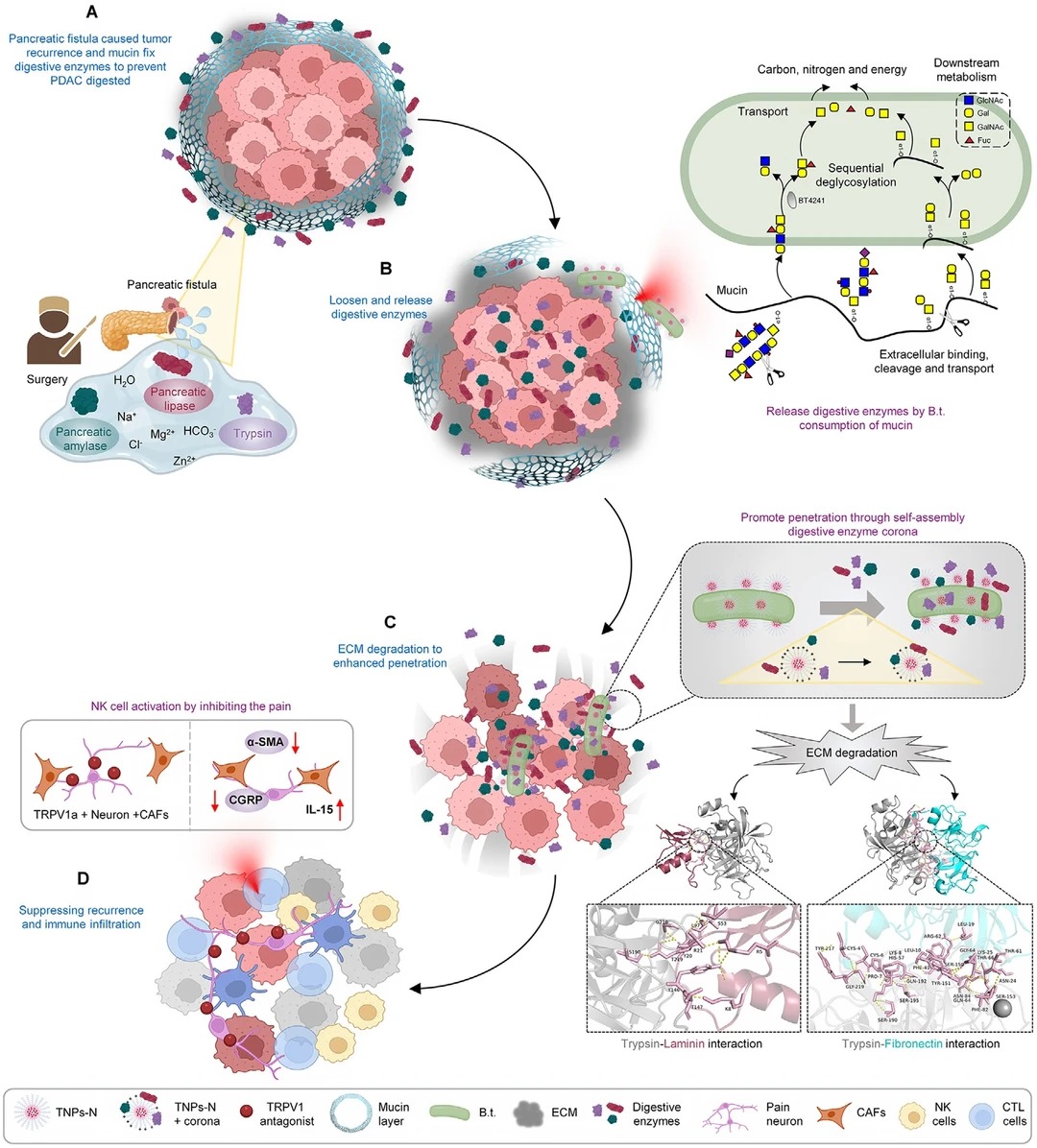
💡Research Highlights: This study designs a TNPs‑N@B.t. composite platform loaded in GelMA hydrogel. Bacteroides are engineered and conjugated with TRPV1 antagonist-loaded nanomicelles, converting pancreatic fluid leakage, a pathological complication after surgery, into an anti-tumor resource. With the help of bacteria degrading mucin, digestive enzyme coronas are formed in situ using pancreatic fluid. Meanwhile, the nerve-cancer-associated fibroblast axis is regulated, and multiple synergistic effects eliminate residual pancreatic ductal adenocarcinoma tumors after surgery.
🔬Innovation Points: Breaking away from the conventional mindset that regards pancreatic fluid leakage merely as a complication, the digestive enzymes in pancreatic fluid are utilized as endogenous therapeutic components; engineered Bacteroides are adopted to remodel nanoparticles via enzyme coronas, turning the adverse effects of protein coronas into advantages for tumor penetration; multiple mechanisms including mucin degradation, enzymatic killing, inhibition of cancer-associated fibroblasts and immune activation are integrated to intervene in both tumors and the postoperative microenvironment simultaneously.
🧪Material Development (1) Materials: Bacteroides thetaiotaomicron (B.t.), amino-functionalized nanomicelles (TNPs‑N), TRPV1 antagonist, and GelMA hydrogel, to construct the TNPs‑N@B.t.+Gel composite system. (2) Functions: B.t. degrades the mucin barrier on the tumor surface; TNPs‑N can adsorb digestive enzymes from pancreatic fluid to form enzyme coronas and improve tumor penetration; the antagonist inhibits the CGRP pathway, weakens the activation of CAFs and assists NK cells in anti-tumor effects; GelMA enables local retention, captures pancreatic fluid, and achieves controlled release of functional units.
📎Extended Perspectives: This platform can be extended to tumor models with high mucin expression; the interaction mechanism between bacteria and protein coronas can be further explored; modular replacement of bacteria and drug-loaded nano-units can be performed to adapt to different postoperative pathological microenvironments.
#Biomaterials #Nanobacteria #Pancreatic Ductal Adenocarcinoma #Postoperative Tumor #Drug Delivery
We provide full-process services for custom material design, including innovative scheme design, fabrication, characterization, and in vitro & in vivo validation (cell and animal studies). Our postdoctoral team with multiple high-impact Q1 publications can tackle your challenging research demands. Our scope covers hydrogels, drug delivery systems, nanomaterials, polymers, liposomes, microneedles and more. We support project design, NSFC proposal writing, and high-quality SCI manuscripts for journals such as AFM, AM and other Q1/Q2 journals. Enquiries are welcome👇
17768014569 (Dr.Gao)
17761925168 (Dr. Zhang)
18013729810 (Dr. Yang)
18915694570
Previous: Daily Ocular Metabolis
Next: Daily Ophthalmology Re


