
Daily Osteoarthritis Research Idea | Single-Cell Atlas Reveals Novel Chondrocyte and Osteoblast Subtypes in Knee Osteoarthritis
(1) Journal Source
Signal Transduction and Targeted Therapy (2025, 10:40).
(2) Title
Original title: Single-cell transcriptomics reveals novel chondrocyte and osteoblast subtypes and their role in knee osteoarthritis pathogenesis.
(3) Research Approach
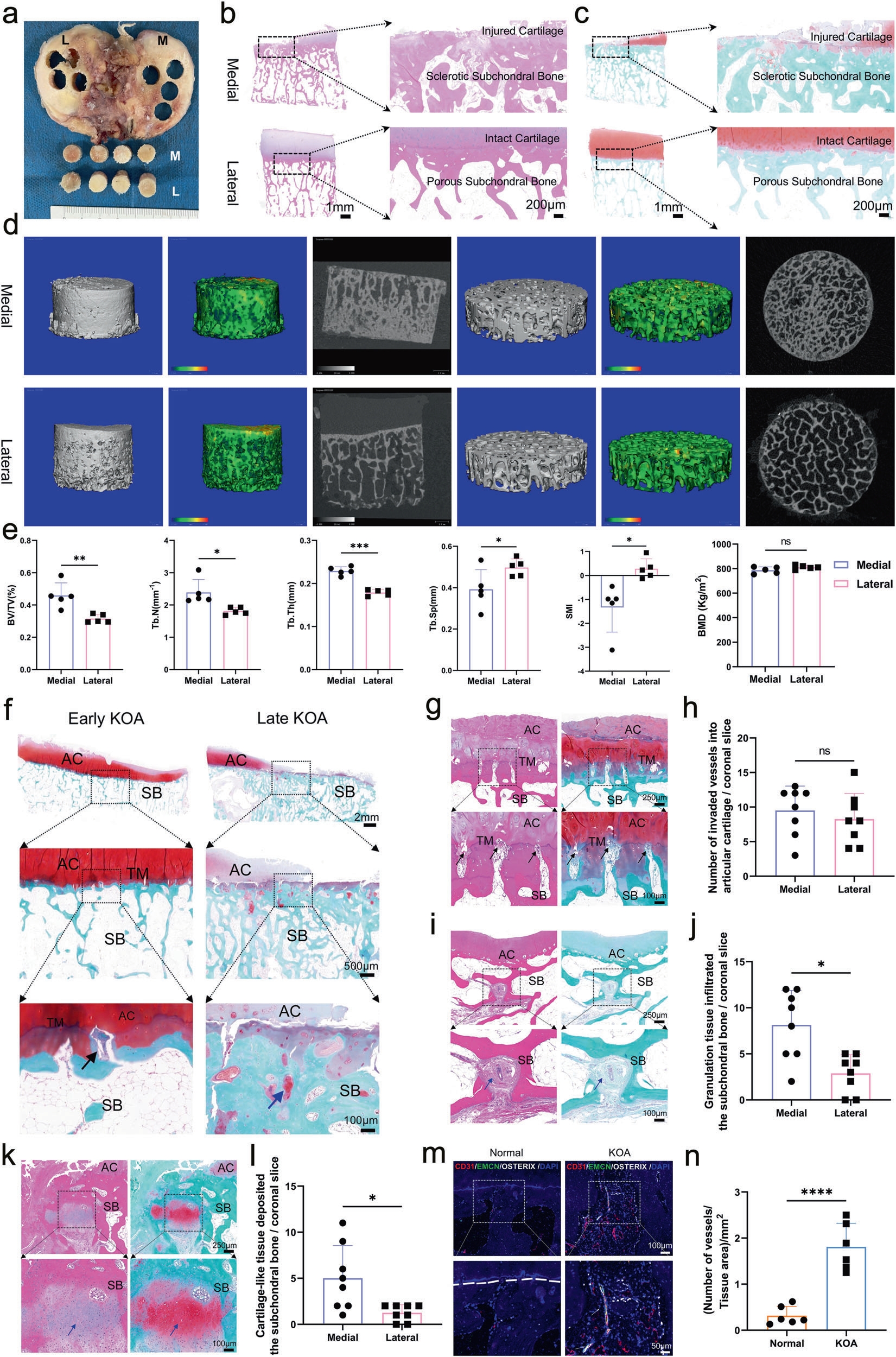
The study first characterized pathological remodeling of the tibial plateau in patients with knee osteoarthritis, including cartilage damage, subchondral bone sclerosis with insufficient mineralization, vascular invasion, cartilage-like tissue deposition, and increased H-type vessels. A postmenopausal knee osteoarthritis mouse model combining bipedal weight-bearing and bilateral ovariectomy was then constructed and evaluated by finite element analysis, gait, imaging, histology, and ultrastructural assessment. Femoral condyle osteochondral composite tissues were further subjected to single-cell RNA sequencing to build a cellular atlas, analyze mechanical stimulus responses and intercellular communication, identify chondrocyte and osteoblast subtypes, and validate their pathological roles through histological and molecular analyses.
(4) Innovation
The work combines estrogen withdrawal with bipedal mechanical loading to establish a mouse model closer to postmenopausal knee osteoarthritis pathological remodeling. It constructs a single-cell atlas of osteochondral composite tissue and simultaneously addresses cellular crosstalk between cartilage degeneration and subchondral bone remodeling. It identifies Smoc2⁺ and Angptl7⁺ angiogenesis-related chondrocytes, Col1a1⁺ osteogenesis-related chondrocytes, and a Sparc⁺ osteoblast subtype. It proposes a framework in which Angptl7⁺ chondrocytes interact with endothelial cells via FGF2–FGFR2 to promote H-type vessel formation and recruit osteoprogenitors, while Sparc⁺ osteoblasts negatively regulate mineralization and osteoblastic differentiation and aggravate pathological subchondral bone remodeling.
(5) Material Development
No new materials, nanomaterials, or delivery systems were developed or characterized. The study used animal models, single-cell RNA sequencing, bioinformatic analysis, histology, and imaging, without material synthesis, carrier construction, or material-performance evaluation.
We provide full-process services for various material designs (including highly innovative scheme design, preparation, characterization, in vitro and in vivo validation (cell/animal experiments), etc.): a postdoctoral team (with multiple high-impact publications in Zone 1 journals) can meet all kinds of tricky and challenging requirements, including hydrogels / drug delivery / nanomaterials / polymers / liposomes / microneedle drug delivery, etc. We can assist with project design / NSFC grant applications / publication of high-impact Zone 1 and Zone 2 papers in journals such as AFM, SCI, AM, etc. Welcome to consult 👇️
17768014569 (Senior Engineer Gao)
17761925168 (Engineer Zhang)
18013729810 (Engineer Yang)
#KneeOsteoarthritis #SingleCellTranscriptomics #ChondrocyteSubtypes #Osteoblasts #SubchondralBoneRemodeling #ResearchServices #SciTalk #ResearchMaterials #BKNano
18915694570
Previous: Custom Nanomaterial Se
Next: Daily Ophthalmology Re


