
Custom Nanomaterial Service | Dynamic Bond Hydrogels for Infected Wound Repair in *Carbohydrate Polymers*
 (1) Journal source: Carbohydrate Polymers
(2) Title: A novel multi‑functional PVA‑alginate hydrogel with dynamic bond crosslinking for infected wound repair
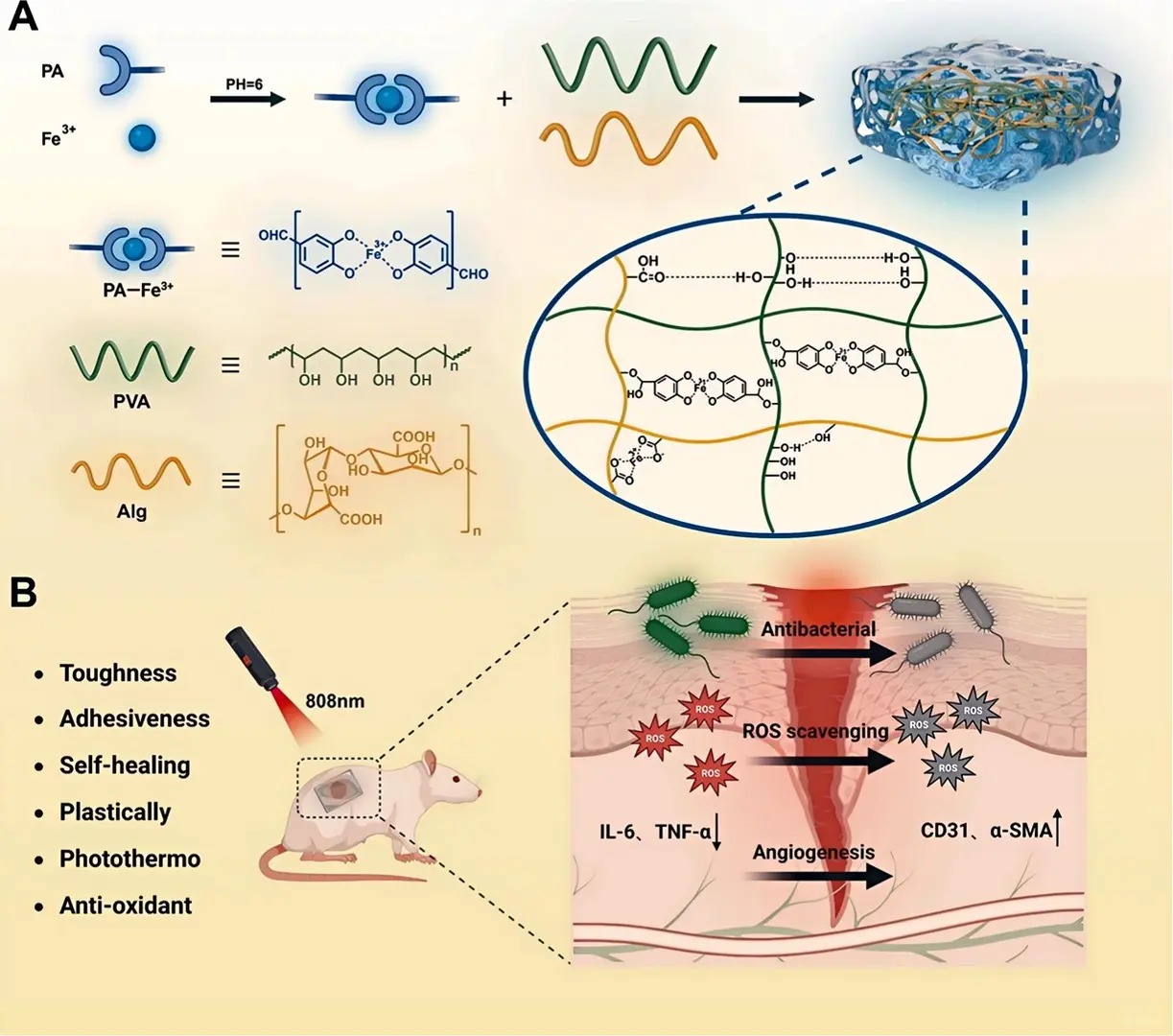
(3) Research highlights: In this work, a multifunctional PVA‑Alg/FP hydrogel crosslinked via multiple dynamic bonds was designed. Iron‑protocatechuic aldehyde chelate was adopted as a natural small‑molecule crosslinker to avoid toxic crosslinkers and complicated modification and purification procedures. The physicochemical properties and biological activities of the hydrogel were systematically investigated, and its wound repair efficacy was evaluated in a full‑thickness skin defect model with bacterial infection.
(4) Innovations: Fe³⁺‑protocatechuic aldehyde chelate was used as the crosslinking unit, and the gel network was constructed by multiple dynamic bonds including hemiacetal bonds, metal coordination bonds and hydrogen bonds; the preparation only involved simple physical mixing. The hydrogel integrates self‑healing, plasticity and tissue adhesion properties, and can undergo responsive disintegration and detachment under the action of deferoxamine. The chelate endows the hydrogel with intrinsic photothermal, antioxidant and anti‑inflammatory activities. Near‑infrared light irradiation synergistically achieves antibacterial effects; the hydrogel promotes cell migration in vitro, ameliorates the microenvironment of infected wounds in vivo and facilitates wound repair.
(1) Materials: Polyvinyl alcohol (PVA), sodium alginate (Alg), ferric ions, protocatechuic aldehyde (PA), deferoxamine (DFO)
(2) Functions: The polymer backbone forms the gel matrix. The Fe³⁺‑PA chelate acts as a crosslinker to build the dynamic network and simultaneously provides photothermal, antioxidant and antibacterial activities. The hydrogel possesses mechanical toughness, self‑healing, adhesion and shaping capacity. DFO can competitively bind ferric ions to realize on‑demand detachment of the gel. The material can alleviate local inflammation, promote cell migration and angiogenesis, and facilitate the healing of infected wounds.
(6) Extended outlook: This facile construction strategy of multiple dynamic bonds can provide a reference for the design of PVA‑based multifunctional wound dressings. Further research can explore the regulation of comprehensive performance by gel formulation and gelation pH, and this dynamic crosslinking system can also be extended to other skin‑related biomaterials.
#MedicineEngineeringInterdiscipline #LiteratureSharing #Biomaterials #Hydrogel #WoundDressing #TissueEngineering #ResearchPaperReading
We provide full-process services for custom material design, including innovative scheme design, fabrication, characterization, and in vitro & in vivo validation (cell and animal studies). Our postdoctoral team with multiple high-impact Q1 publications can tackle your challenging research demands. Our scope covers hydrogels, drug delivery systems, nanomaterials, polymers, liposomes, microneedles and more. We support project design, NSFC proposal writing, and high-quality SCI manuscripts for journals such as AFM, AM and other Q1/Q2 journals. Enquiries are welcome👇
17768014569 (Dr.Gao)
17761925168 (Dr. Zhang)
18013729810 (Dr. Yang)
18915694570
Previous: Daily Cornea Idea | St
Next: Daily Ophthalmology Re


