

Daily Tendon–Bone Interface Research Idea | Mitochondrial Nanoplatform Reprograms Tendon–Bone Interface Bioenergetics
(1) Journal Source
Journal of Nanobiotechnology (2026).
(2) Title
Original title: A mitochondria-derived multicellular 3D-bioprinted gradient scaffold reprograms the bioenergetic microenvironment for functional tendon-bone interface regeneration.
(3) Research Approach
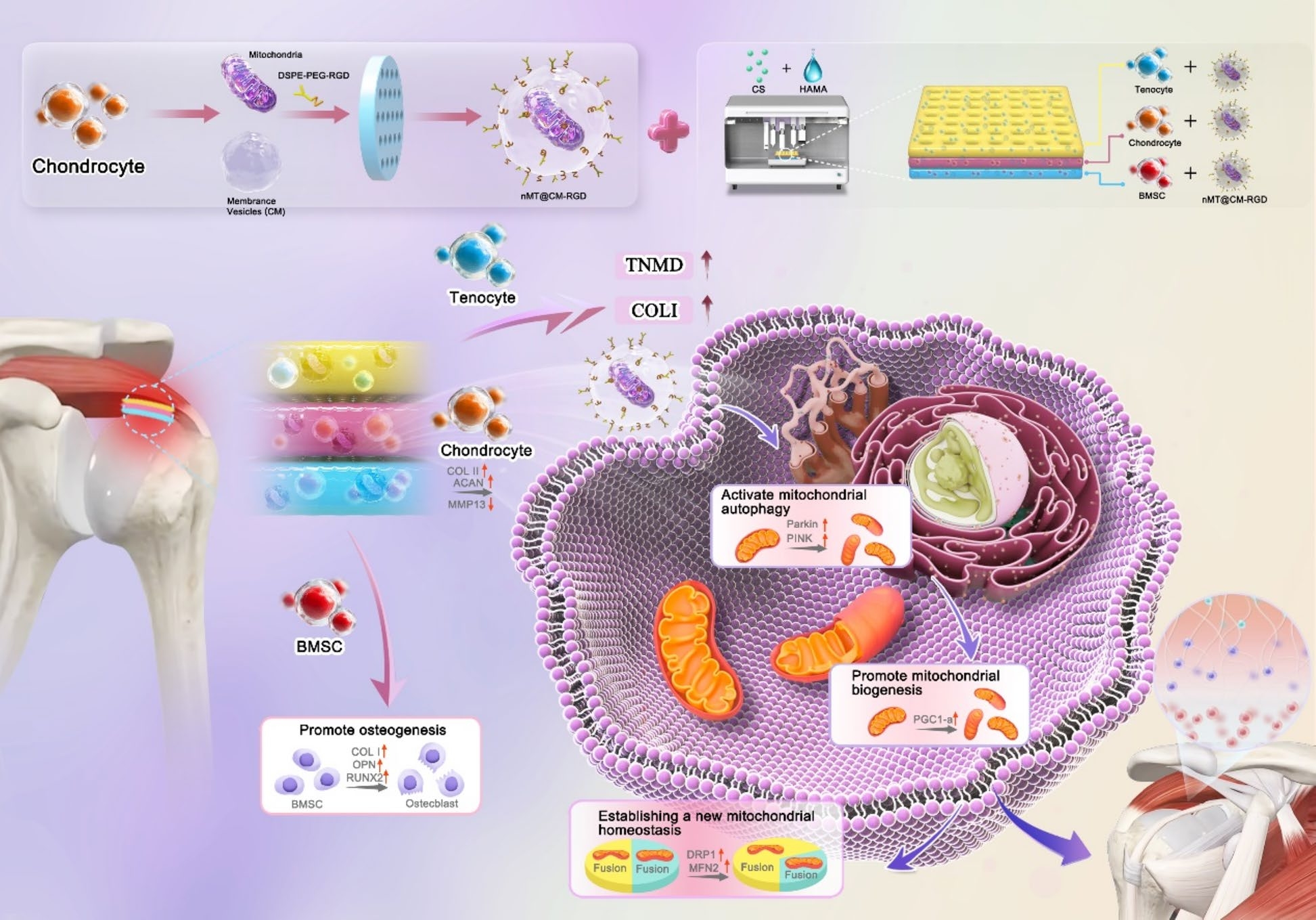
Targeting inflammation-induced mitochondrial dysfunction and glycolytic shift, the study constructs RGD-modified, chondrocyte membrane-cloaked mitochondrial nanoparticles (nMT@CM-RGD). Under IL-1β inflammatory conditions, it evaluates cellular uptake, lysosomal escape, mitochondrial function, metabolic reprogramming, and NF-κB/PKM2 and PINK1/Parkin-related pathways, as well as phenotype maintenance and differentiation of chondrocytes, BMSCs, and tenocytes. The nanosystem is then incorporated into a tri-cellular layer-by-layer 3D-bioprinted CS/HAMA gradient scaffold (MitoGel-Trio), which is evaluated in a rat rotator cuff injury model by gait, MRI, biomechanics, micro-CT, histology, and immunohistochemistry.
(4) Innovation
It combines mitochondrial nanoengineering with a multicellular 3D-bioprinted gradient scaffold, integrating inflammatory bioenergetic remodeling with tendon–fibrocartilage–bone spatial hierarchy biomimicry. Chondrocyte membrane homotypic targeting and RGD–integrin recognition improve delivery and reduce lysosomal sequestration. The work proposes a shift from inflammatory glycolysis toward oxidative phosphorylation and mechanisms related to NF-κB/PKM2 and PINK1/Parkin-mediated mitophagy. Multicellular phenotype coordination supports multiregional interface regeneration.
(5) Material Development
nMT@CM-RGD is assembled by extrusion of isolated mitochondria, chondrocyte membranes, and DSPE-PEG-RGD, with characterization of morphology, size, potential, membrane coating, stability, ATP/SOD retention, cellular uptake, and lysosomal escape. CS/HAMA composite hydrogels with different CS concentrations are screened for porosity, hydrophilicity, rheology, mechanics, degradation, cytocompatibility, and phenotype support. HAMA-4CS is selected as the bioink, loaded with nMT@CM-RGD, and used for tri-cellular layered printing to construct MitoGel-Trio.
We provide full-process services for various material designs (including highly innovative scheme design, preparation, characterization, in vitro and in vivo validation (cell/animal experiments), etc.): a postdoctoral team (with multiple high-impact publications in Zone 1 journals) can meet all kinds of tricky and challenging requirements, including hydrogels / drug delivery / nanomaterials / polymers / liposomes / microneedle drug delivery, etc. We can assist with project design / NSFC grant applications / publication of high-impact Zone 1 and Zone 2 papers in journals such as AFM, SCI, AM, etc. Welcome to consult 👇️
17768014569 (Senior Engineer Gao)
17761925168 (Engineer Zhang)
18013729810 (Engineer Yang)
#MitochondrialNanoengineering #Multicellular3DBioprinting #GradientScaffold #TendonBoneInterface #Mitophagy #Nanomaterials #Nanoparticles #NanoDrugs #NanomaterialSynthesis #LifeSciences #ResearchServices #ScientificResearch #BKNano
18915694570
Previous: Custom Nanomaterial Se
Next: Daily Ophthalmology Re


