

Daily Bone Regeneration Idea | Hypoxic Biomimetic Barrier Safeguards Stable Cartilage Regeneration
(1) Abstract
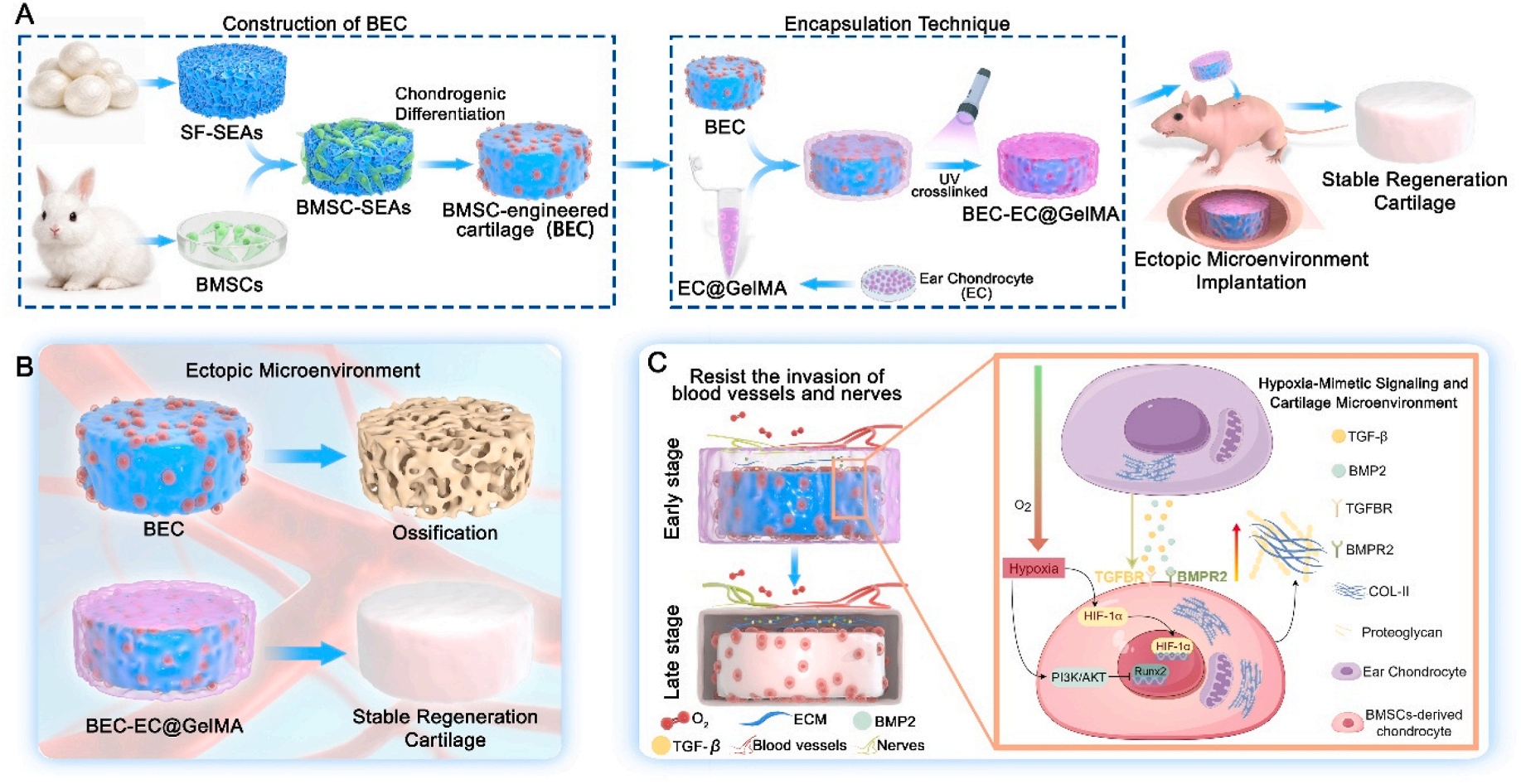
BMSC-engineered cartilage is prone to endochondral ossification in vascularized and innervated subcutaneous ectopic environments, leading to unstable cartilage regeneration. This study constructs a chondrocyte–GelMA (EC@GelMA) living-cell encapsulation coating that forms a dual hypoxic biomimetic and biological shield on engineered cartilage, isolating host blood vessels and nerves while maintaining the chondrogenic phenotype of encapsulated BMSCs and stable cartilage regeneration.
(2) Background
Cartilage is avascular and aneural with limited self-repair. BMSCs are commonly used seed cells in cartilage tissue engineering, but after ectopic implantation, host vessel and nerve invasion can provide nutrients and osteoinductive signals, promoting chondrocyte hypertrophy, calcification, and endochondral ossification. Conventional BMSC–chondrocyte co-culture or anti-angiogenic drug delivery strategies have limitations such as uncontrolled cell interactions, high chondrocyte demand, passive action, or unsustainable release.
(3) Main Content
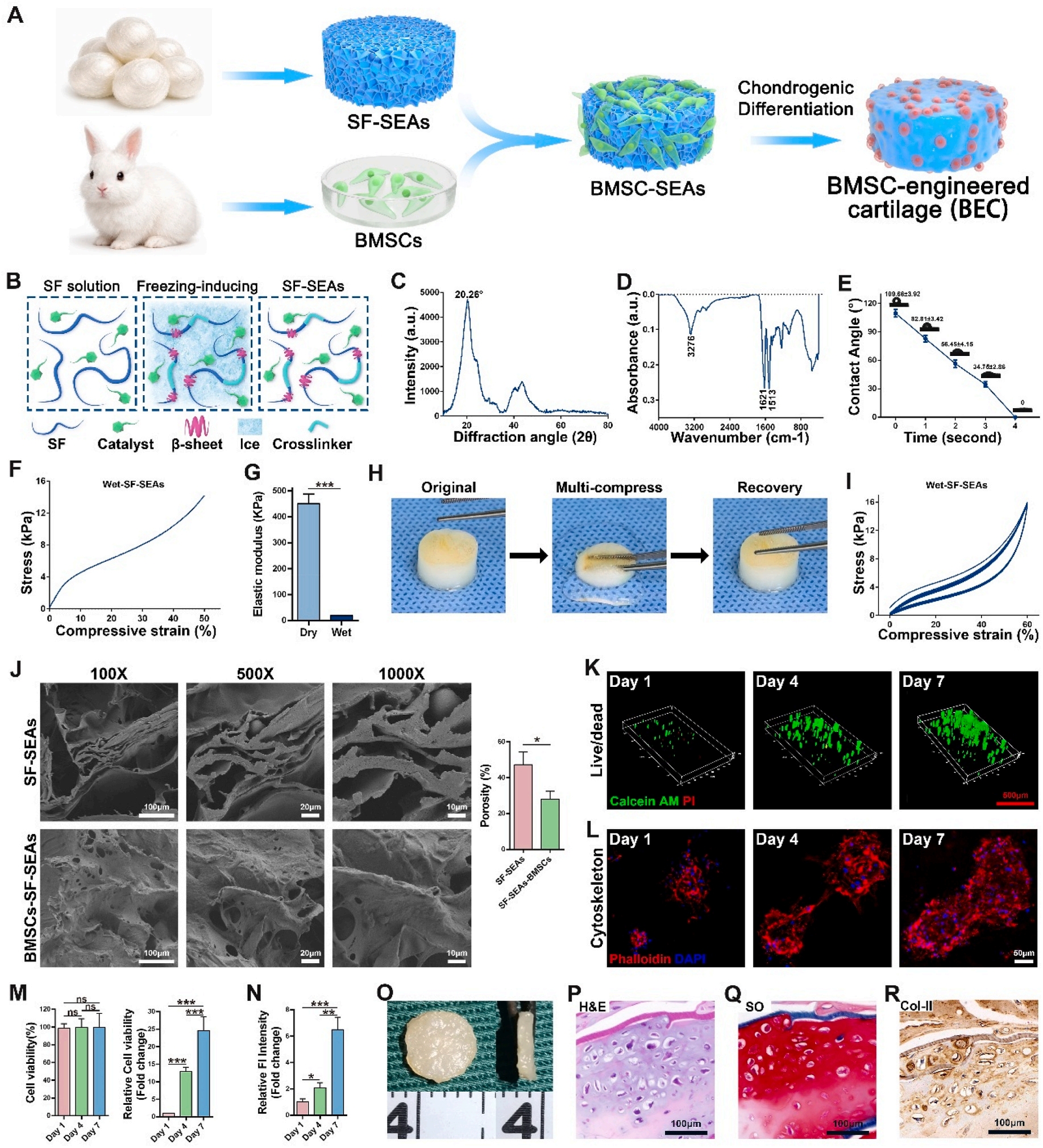
Silk fibroin superelastic absorbent scaffolds (SF-SEAs) were used to carry BMSCs and form engineered cartilage, followed by multilayer EC@GelMA encapsulation. The article covers scaffold physicochemical and cytocompatibility characterization, engineered cartilage construction, encapsulation layer optimization and tracing, transcriptomics and oxygen distribution simulation, HIF-1-related pathway validation, and assessment of ossification, vessels, and nerves after subcutaneous ectopic implantation.
(4) Study Design
SF-SEAs were characterized for morphology, hydrophilicity, mechanics, and cytocompatibility in vitro. BMSCs were seeded and chondrogenically induced to construct engineered cartilage. Fluorescently labeled BMSCs and chondrocytes were used to compare encapsulation layers and select an appropriate thickness. Transcriptome sequencing, GO/KEGG/GSEA analysis, and oxygen diffusion simulation were performed, with HIF-1α and VEGF detection. Unencapsulated, GelMA-encapsulated, and EC@GelMA-encapsulated constructs were implanted subcutaneously in nude mice and evaluated by gross observation, micro-CT, histology, immunohistochemistry, vessel/nerve marker immunofluorescence, and biosafety assessment.
(5) Results
SF-SEAs showed favorable hydrophilicity, elasticity, and cytocompatibility, supporting BMSC adhesion, survival, and chondrogenic differentiation. EC@GelMA achieved relatively complete encapsulation and provided a hypoxic biomimetic microenvironment, enriching hypoxia response, HIF-1, PI3K-Akt, and cartilage-related signaling. After subcutaneous implantation, unencapsulated and GelMA-only groups showed obvious ossification, whereas the EC@GelMA group maintained cartilage-like tissue with more mature cartilage matrix deposition, lower vessel and nerve markers, and no obvious histological abnormalities in major organs.
(6) Future Directions
Further studies should validate stability in large animals and longer observation windows, use chondrocyte secretome analysis and inhibitor/agonist rescue to identify effector molecules, and distinguish physical shielding from biological regulation. Programmable and reproducible encapsulation processes should be developed, and barrier performance and cartilage phenotype maintenance should be evaluated in models closer to craniofacial cartilage mechanical loading and immune microenvironment.
We provide full-process services for various material designs (including highly innovative scheme design, preparation, characterization, in vitro and in vivo validation (cell/animal experiments), etc.): a postdoctoral team (with multiple high-impact publications in Zone 1 journals) can meet all kinds of tricky and challenging requirements, including hydrogels / drug delivery / nanomaterials / polymers / liposomes / microneedle drug delivery, etc. We can assist with project design / NSFC grant applications / publication of high-impact Zone 1 and Zone 2 papers in journals such as AFM, SCI, AM, etc. Welcome to consult 👇️
17768014569 (Senior Engineer Gao)
17761925168 (Engineer Zhang)
18013729810 (Engineer Yang)
18915694570
Previous: Custom Nanomaterial Se
Next: Custom Nanomaterial Se


