

Custom Nanomaterial Service | Journal of Nanobiotechnology: Cardiac-Targeted Nanozyme Delivering miRNA for Cardioprotection and Anti-Fibrosis
Title
Cardiac-targeted delivery of miRNA via antioxidant nanozymes ameliorates cardiac dysfunction and fibrosis after myocardial infarction
Research Background
Following myocardial infarction, oxidative stress, inflammation, apoptosis and dysregulated autophagy are intertwined within the ischemic region. The activation of fibroblasts further drives fibrotic remodeling, which progresses toward heart failure. Reperfusion merely recanalizes blood vessels and fails to block this cascade. miR 26a protects mitochondria and suppresses apoptosis; however, rapid blood flow in the heart and susceptibility of nucleic acids to degradation limit its delivery performance and myocardial specificity. ROS-scavenging nanozymes alone cannot resolve genetic dysregulation. There is a demand for an integrated carrier combining catalytic activity and nucleic acid delivery.
Research Design
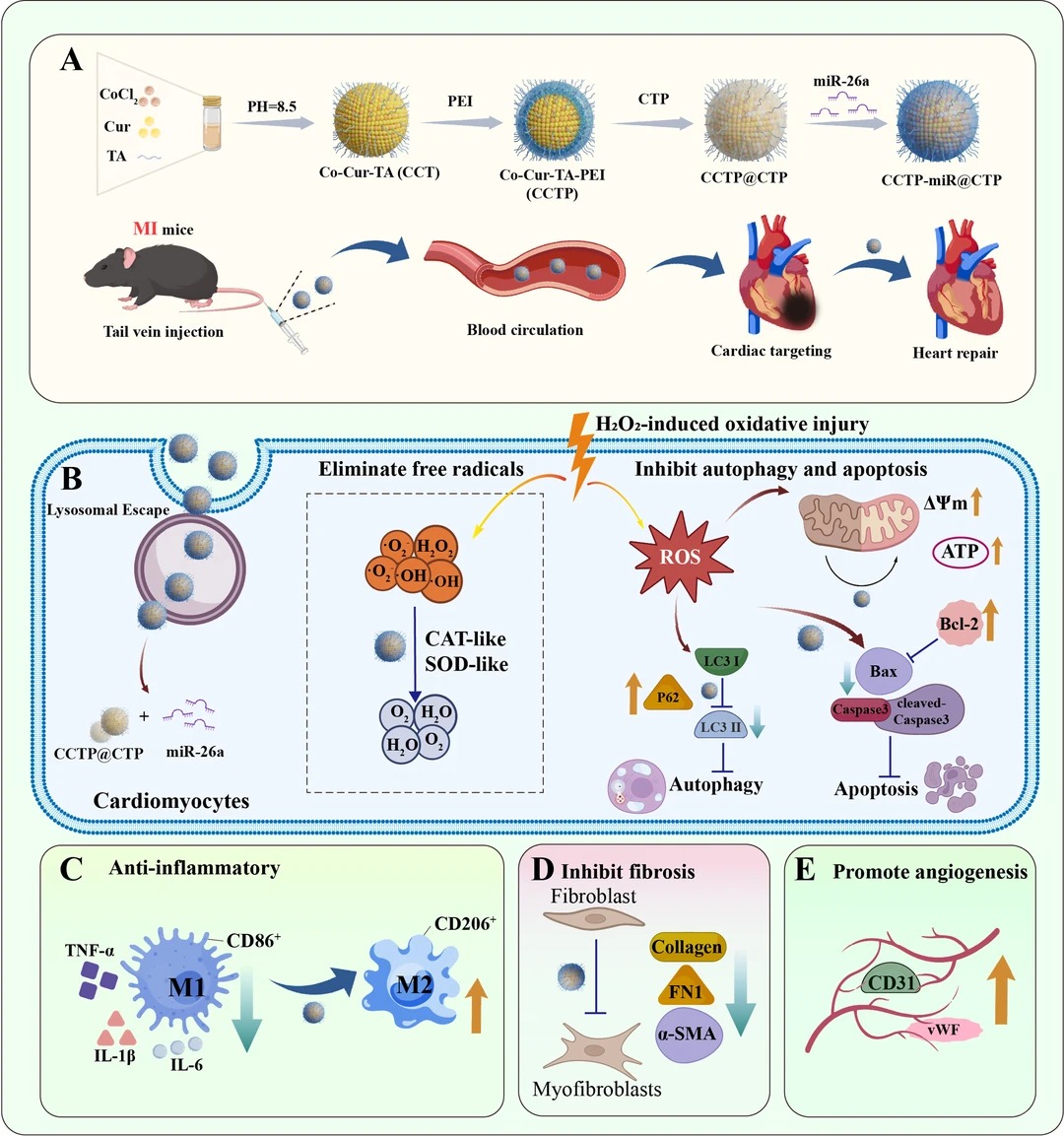
The researchers fabricated nanozyme cores via coordination self-assembly of cobalt, curcumin and tannic acid. The cores were coated with PEI-g-PEG to load miR 26a, and further functionalized with the cardiac-targeting peptide CTP. The Co²⁺/Co³⁺ redox pair endows the system with SOD-like and CAT-like activity to eliminate superoxide anions and hydrogen peroxide. CTP facilitates accumulation of nanoparticles in the infarcted myocardium. After internalization by cardiomyocytes, miR 26a is released to restrain excessive autophagy and apoptosis, promote M2 macrophage polarization and support angiogenesis. The target sites include infarcted myocardium and cardiomyocytes.
Commentary on the Work
This design integrates ROS scavenging and gene supplementation within a single nanoparticle. The nanozyme preserves mitochondrial homeostasis while the miRNA modulates transcription, with well-defined functional division. In vitro assays were performed sequentially to examine ROS levels, membrane potential, ATP content, autophagic flux and apoptosis. In vivo acute and chronic models were adopted to evaluate cardiac function and infarct size, with fibrosis and vascular density assessed at day 28. The study is limited to mouse models without validation in large animals. The safety profile and cardiac selectivity upon repeated long-term administration remain to be optimized. Overall, it provides meaningful references for multi-modal intervention against myocardial infarction.
We provide full-process services for custom material design, including innovative scheme design, fabrication, characterization, and in vitro & in vivo validation (cell and animal studies). Our postdoctoral team with multiple high-impact Q1 publications can tackle your challenging research demands. Our scope covers hydrogels, drug delivery systems, nanomaterials, polymers, liposomes, microneedles and more. We support project design, NSFC proposal writing, and high-quality SCI manuscripts for journals such as AFM, AM and other Q1/Q2 journals. Enquiries are welcome
17768014569 (Dr.Gao)
17761925168 (Dr. Zhang)
18013729810 (Dr. Yang)
18915694570
Previous: Custom Nanomaterial Se
Next: Custom Nanomaterial Se


