

Custom Nanomaterial Service | Machine Learning for PK‑PD Relationships of Nanoparticles in Tumors, *ACS Nano*
Journal Source ACS Nano
Title Analysis of Pharmacokinetic−Pharmacodynamic Relationships of Nanoparticles against Tumors
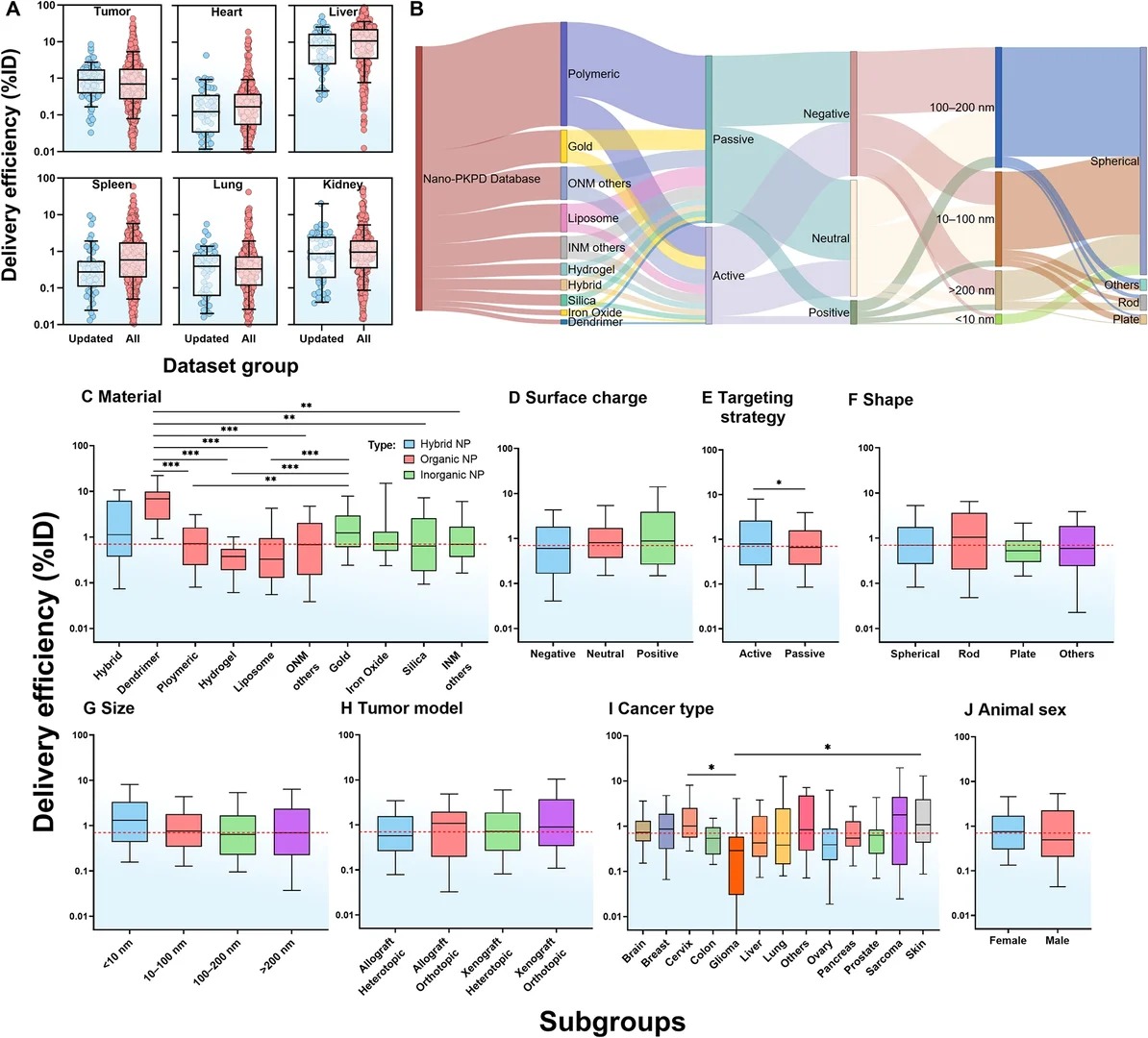
Research Idea This study integrates publicly‑available tumor‑focused nanomedicine datasets and supplementary literature‑sourced data to build an integrated nanopharmacokinetic‑pharmacodynamic database. It compiles in‑vivo tissue‑distribution and tumor‑accumulation pharmacokinetic data of nanoparticles, alongside pharmacodynamic data for tumor‑growth inhibition. Group‑wise statistical analysis is conducted to interpret the effects of nanoparticle physicochemical properties, experimental protocols and administration regimens on pharmacokinetic and pharmacodynamic endpoints. Multiple machine‑learning models are constructed incorporating nanoparticle physicochemical features, administration parameters and pharmacokinetic signatures to dissect PK‑PD correlations. Model‑interpretation tools are adopted to identify key influencing variables and infer optimal parameter ranges for nanoparticle design.
Innovations
- The first standardized public database that simultaneously integrates time‑series pharmacokinetic data of nanoparticle tumor accumulation and time‑series anti‑tumor pharmacodynamic data.
- AI‑aided physiologically‑based pharmacokinetic model is introduced to fill missing pharmacokinetic parameters in pharmacodynamic experiments, enabling joint PK‑PD modelling.
- Tree‑based ensemble machine learning combined with SHAP and generalized additive models quantifies the nonlinear effects of individual features on anti‑tumor efficacy, and defines optimal feature ranges to guide formulation development.
- Systematically compares the differential regulatory patterns of in‑vivo distribution and tumor‑inhibition efficacy governed by nanoparticle materials, particle sizes, surface charges, targeting strategies and auxiliary stimulation techniques.
Material Development (1) Materials: Organic, inorganic and hybrid nanocarriers are collected, covering mainstream nanomatrices including polymers, liposomes, dendrimers, gold, iron oxide and silica. (2) Functions: Carriers support single‑drug / dual‑drug co‑delivery. Equipped with active‑targeting modification and external‑triggered technologies such as light, magnetism and ultrasound, they modulate in‑vivo tissue enrichment, tumor penetration and drug release to achieve tumor‑growth inhibition.
We provide full‑cycle services covering diverse material design (including highly‑innovative scheme design, preparation, characterization, and in‑vitro & in‑vivo validation (cell / animal experiments)). Supported by a postdoctoral team with multiple high‑impact Q1 journal publications, we address sophisticated and challenging research demands, including hydrogels, drug delivery, nanomaterials, polymers, liposomes, microneedle‑based drug delivery and more. We also offer project design, National Natural Science Foundation application assistance, and support for publishing high‑rank Q1/Q2 SCI papers in journals such as AFM and AM. Feel free to reach out👇
+86‑17768014569 (Engineer Gao)
+86‑17761925168 (Engineer Zhang)
+86‑18013729810 (Engineer Yang)
#Nanomaterials #CustomNanomaterials #BeikeNano #bknano #Tumor #Nanoparticles #Nanomedicine #LifeScience #ResearchService #NanomaterialSynthesis #SCI #ResearchMaterials
18915694570
Previous: BK Oncolytic virus pla
Next: Atomic-level Regulatio


