

Ultrasound-Driven Nanomotors and Targeted Piezocatalytic Thrombolysis
Nanomotors are adopted to realize precise targeting and mechanical penetration of thrombi. Such nanomotors feature a Janus structure composed of hollow barium titanate (hBT) and asymmetrically deposited platinum (Pt), and their surfaces are coated with platelet membranes (Pm). After the nanomotors enter the blood circulation, specific proteins on the platelet membranes can guide them to accurately recognize and accumulate at thrombus sites. Under an ultrasonic field, the asymmetric Pt structure triggers local cavitation effects and generates propulsion from microbubbles, endowing the nanomotors with strong mechanical penetration capacity to penetrate deep into the internal matrix of thrombi.
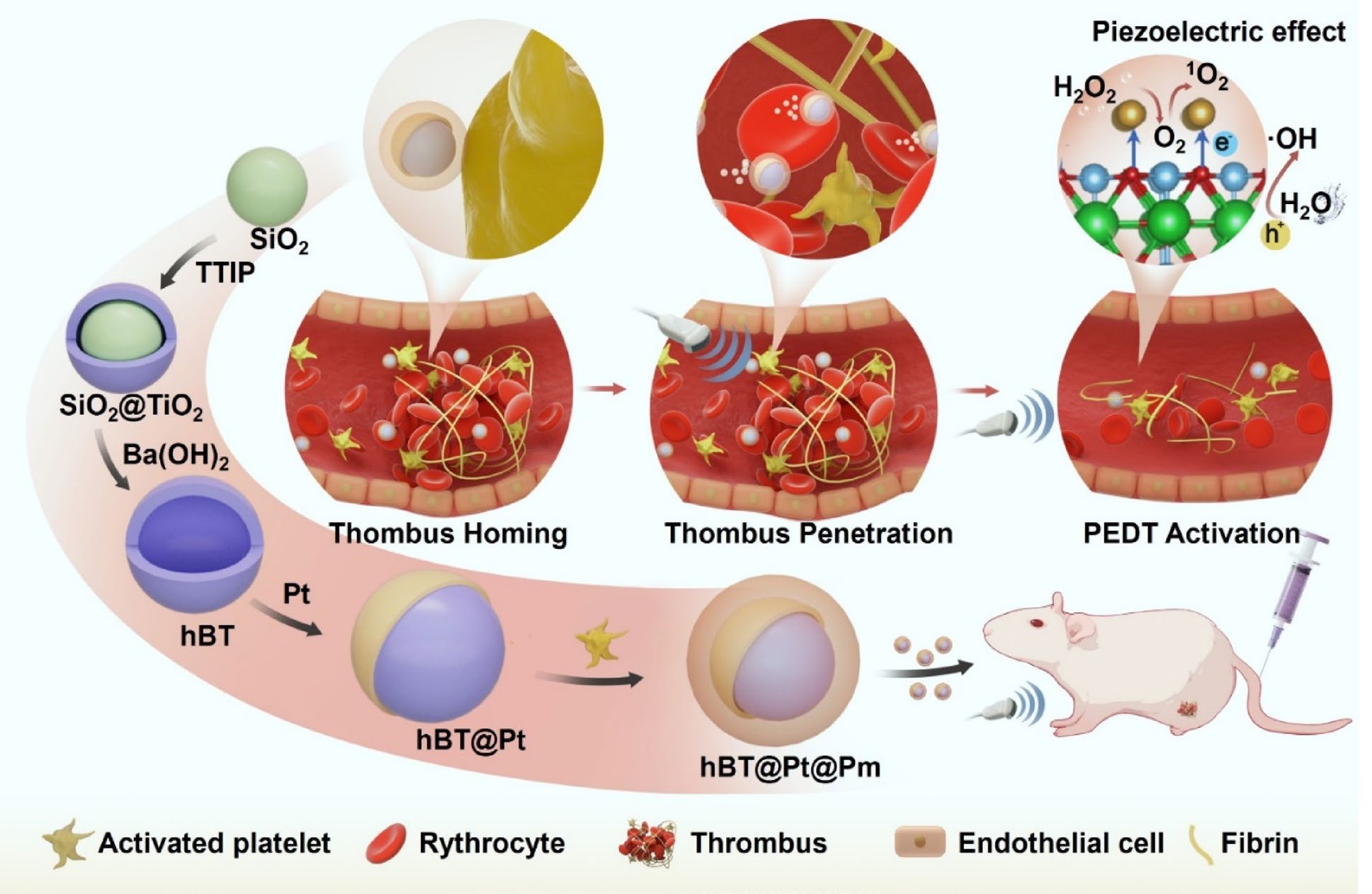
Piezoelectric catalysis is utilized for efficient thrombus degradation. These nanomotors exploit the Schottky heterojunction formed by hollow BaTiO₃ and Pt. Upon ultrasonic excitation, hBT produces a piezoelectric effect, and the built-in electric field of the heterojunction effectively facilitates the separation of electrons and holes and suppresses carrier recombination. The separated charges further react with oxygen and water molecules in the surroundings to generate abundant reactive oxygen species (ROS) in situ, which precisely disrupt thrombus structures by destroying fibrin skeletons and peptide bonds.
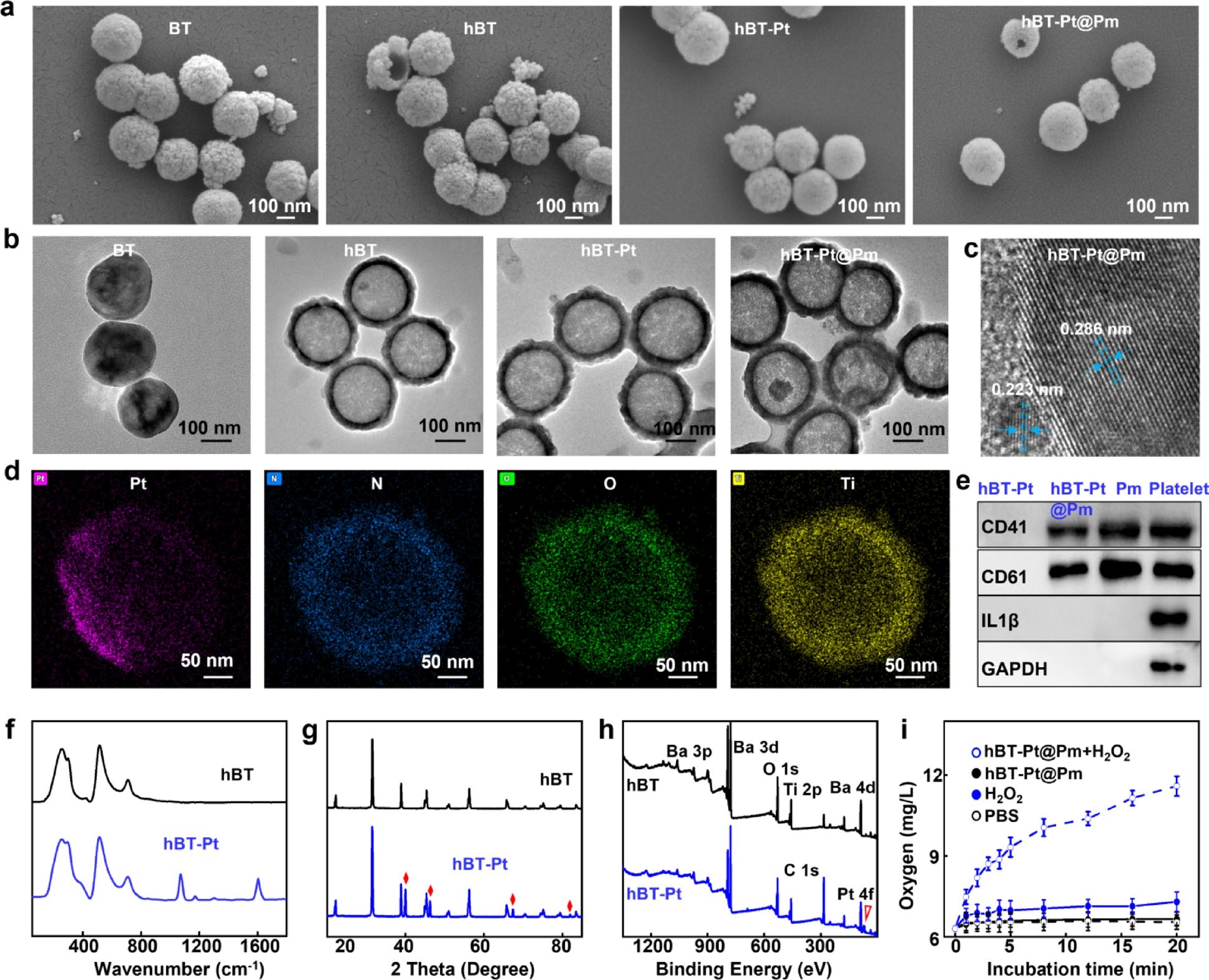
Microenvironment catalysis is used to relieve hypoxia and amplify the ROS burst. Relying on the catalase-like activity of the Pt layer, these nanomotors catalyze the decomposition of hydrogen peroxide to produce oxygen in the local microenvironment of thrombi. This process not only alleviates hypoxia at thrombus sites; the generated oxygen bubbles further boost the autonomous movement and penetration of the motors. Meanwhile, it continuously supplies substrates for piezoelectric catalytic reactions and synergistically amplifies ROS production efficiency, offering a novel nanocatalytic strategy for targeted, drug-free thrombolytic therapy.
We provide full-process services for the design of various materials, including highly innovative scheme design, preparation, characterization, and in vitro & in vivo validation (cell/animal experiments). Our postdoctoral team, with multiple high-impact Q1 publications, can address your most challenging and sophisticated research needs covering hydrogels, drug delivery, nanomaterials, polymers, liposomes, microneedle drug delivery and more. We support project design, National Natural Science Foundation application, and publication of high-impact Q1/Q2 papers such as AFM, SCI and AM. Feel free to reach out👇️
17768014569 (Senior Engineer)
17761925168 (Engineer Zhang)
18013729810 (Engineer Yang)
18915694570
Previous: BK Oncolytic virus pla
Next: Atomic-level Regulatio


